


TL;DR
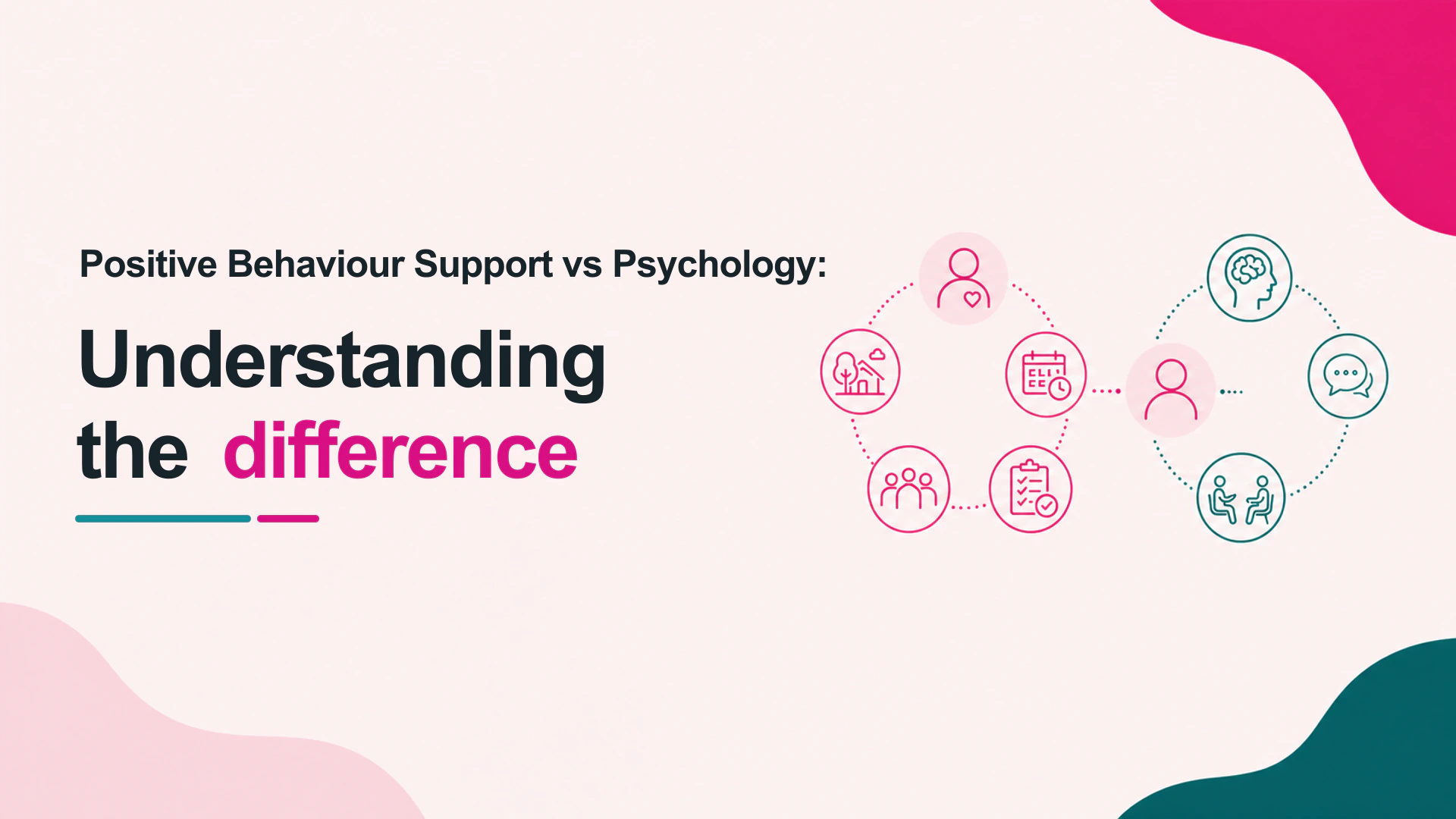
Positive behaviour support (PBS) and psychology are different services, even though the same qualified person can sometimes deliver either one. PBS works on what’s happening around a person (their environment, routines and support team) to build quality of life and skills; psychology looks at the person’s internal experience, usually one-to-one. A psychologist can absolutely work as a PBS practitioner, but if what’s contracted and funded is PBS, what gets delivered has to be PBS, not psychological therapy. If restrictive practices are in place, or look likely to be needed, PBS should be part of the referral regardless of what else is going on: that’s specifically PBS territory.
You might be a parent or guardian trying to work out why your child has both supports, or one and not the other. You might also coordinate supports for NDIS participants and face the same fork: does this person need positive behaviour support, psychology, or both?
This guide sets out how the two differ, where a dual-qualified practitioner fits in, and when restrictive practices should tell you PBS needs to be in the picture.
- 1
Two Different Jobs
PBS looks outward, psychology looks inward
- 2
Which Fits
Match the participant's signals to the right service
- 3
Contract Decides
Same practitioner, different engagement, different rules
- 4
RPs = PBS
Restrictive practices always need PBS in the picture
Two services, two different jobs
Positive behaviour support looks outward. It aims to increase a person’s quality of life, understand the reasons for their behaviour, meet their needs, and reduce behaviours of concern over time. It does this through skill development, environmental change, and guidance for the support team.
Quality of life sits at the centre of that, and function (understanding why a behaviour happens) is one of the tools PBS uses to get there. It’s a person-centred approach, drawing on behavioural science alongside environmental and systems change to improve a person’s life and reduce challenging behaviour over time.
Psychology looks inward. It addresses the person’s thoughts, emotions, mental health and coping, usually through a one-to-one therapeutic relationship with a psychologist registered with the Psychology Board of Australia.
Psychologists can also conduct psychological and diagnostic assessments. Within their AHPRA scope of practice, they can diagnose certain mental health conditions, such as anxiety disorders, depression, and PTSD. Some diagnoses, including autism spectrum disorder and ADHD, are typically reached through a multidisciplinary assessment involving other specialists as well, rather than by a psychologist alone. ORS offers these assessments.
Both are evidence-based, and both can be NDIS-funded. They aren’t interchangeable, and having one in place doesn’t guarantee the other is covered.
PBS
- Purpose
- Understand why a behaviour is happening, and change the environment and supports around the person to improve their quality of life.
- Assessment
- Functional behaviour assessment. Identifies why a behaviour occurs. Not a mental health diagnosis.
- Primary relationship
- Works through the support network as much as directly with the participant: training and coaching support staff and family.
- Funded under
- Capacity Building: Behaviour Support (Improved Relationships on legacy plans).
- Success measured by
- Reduced behaviours of concern and restrictive practice use; improved quality of life (behavioural data).
Psychology
- Purpose
- Understand and change internal experience (thoughts, emotions, trauma) through direct clinical work with the person.
- Assessment
- Conducts psychological assessments and can diagnose certain mental health conditions (e.g. anxiety, depression, PTSD).
- Primary relationship
- An ongoing one-to-one therapeutic relationship with the participant.
- Funded under
- Capacity Building: Improved Daily Living.
- Success measured by
- Symptom reduction, insight and improved coping (clinical outcomes).
Which one does this participant actually need?
A few signals help sort this quickly. Many participants will show a mix of both columns; that’s normal, and often means both supports are warranted.
Signs PBS may fit
- Behaviours of concern are affecting safety, relationships or participation
- The support team needs guidance on responding consistently
- Environmental or routine changes seem likely to reduce the behaviour
- Restrictive practices are (or may need to be) in place
Signs psychology may fit
- Anxiety, low mood, grief or trauma symptoms are present
- The person wants or would benefit from one-to-one talking support
- The focus is coping, emotional regulation, or processing an experience
- The person can engage in reflective, one-to-one conversation
Signals from both columns aren’t a contradiction. It’s often the most accurate read of what the person needs, and it’s common for both supports to be in place at once.
A psychologist can deliver PBS, but the contract decides what they actually do
A question we hear often:
“Why doesn’t my child’s PBS practitioner just help with the anxiety too, since they’re clearly capable of it?”
It’s a fair question, and a common one, especially when the practitioner in the room happens to be a registered psychologist. The answer comes down to the contract, not the person’s ability.
Positive behaviour support grew out of the same discipline as psychology, so it’s common to find practitioners who are registered psychologists working as PBS practitioners. That overlap in qualifications is normal, and on its own it tells you nothing about what a specific engagement should look like.
What decides that is the contract and the funding behind it. If your child is receiving PBS, that means the family and the NDIS have agreed to fund positive behaviour support (functional assessment, environmental strategies, skill-building, and guidance for the people around your child). Even if the practitioner is fully qualified to help with the anxiety directly, doing that inside a PBS session quietly changes the service into something different from what was agreed to and funded. If the anxiety needs its own attention, the right step is a separate psychology referral, not folding it into the PBS sessions, however capable the practitioner is.
The clearer way to draw this line isn’t “feelings vs no feelings.” PBS regularly explores feelings where they’re relevant to a behaviour.
The real distinction is root cause versus behaviour:
Root cause
Underlying condition
e.g. trauma, grief, an anxiety disorder
Behaviour
Behaviour of concern
e.g. outbursts, escalation, withdrawal
A participant having trauma-related outbursts is a good example. PBS can look at what triggers an outburst and build strategies with the support team to respond to it. It isn’t the service that treats the trauma driving it, though; that’s psychology’s job. If a dual-qualified practitioner engaged for PBS starts working directly on the trauma itself, rather than the behaviour connected to it, that’s the sign the engagement has shifted into therapy. The right response is a separate psychology referral, alongside the existing PBS support rather than folded into it.
If restrictive practices are involved, or likely to be, PBS is needed
This is one of the clearest signals available whether you’re a parent or a referrer. “Restrictive practices” means things like physical restraint, chemical restraint, seclusion, or restricting a person’s access to something as a way of managing their behaviour. If these are already in place, or the situation looks like it’s heading that way, positive behaviour support should be part of the picture. That holds regardless of whatever else is happening for that person.
Restrictive practices are governed by their own process (a behaviour support plan, and a state or territory authorisation), and both are PBS functions. Psychology doesn’t cover this ground. A psychologist working one-to-one with a participant on their emotional experience isn’t positioned to plan for reducing a restrictive practice; that takes the functional, environmental, whole-of-support-team view PBS provides.
Don’t let a psychology referral substitute for a PBS referral when restrictive practices are on the table. Psychology can still run alongside PBS if the participant needs both, but PBS needs to be there.
How each is funded
They’re different NDIS sub-categories, funded and assessed separately, and having one in place doesn’t automatically cover the other:
PBS is funded under
Capacity Building: Behaviour Support
Improved Relationships on legacy plans
Psychology is funded under
Capacity Building: Improved Daily Living
Different sub-category, assessed separately
If a request gets declined as “duplication”
A common, frustrating pattern: a participant is refused psychology (or occasionally PBS) funding on the basis that the other service is already in place and can cover it. That’s a decision about an individual request, not a rule that one service replaces the other.
The usual fix:
- 1
Step 1: Addendum
Treating practitioners spell out what each service is doing, and why both are needed
- 2
Step 2: Request reconsideration
A decline on one request isn't a ruling that the two services overlap
When to bring in a provider who does both
There’s a practical advantage to referring to a provider that delivers both PBS and psychology: the two teams can align their input on a shared participant, rather than you having to broker that conversation between two unrelated services.
Our positive behaviour support team and psychology team work with participants, families and support coordinators across Australia, and can advise on which service (or combination) fits a specific participant. All referrals and enquiries are welcome. simply fill out the form below and our team will be in touch!
Frequently Asked Questions
What's the simplest way to explain the difference to a participant or family?
Positive behaviour support looks at what's happening around the person (their routines, environment and support team) to reduce behaviours of concern. Psychology looks at what's happening inside the person (their thoughts, emotions and mental health) through one-to-one therapy.
Can a psychologist work as a PBS practitioner?
Yes, many PBS practitioners are also registered psychologists, and that dual qualification is common. What matters is the engagement: if someone is contracted and funded to deliver PBS, the sessions need to stay PBS, even though the practitioner could also deliver therapy. If therapy is what's needed, that's a separate psychology referral.
My participant has restrictive practices in place. Do they need PBS, psychology, or both?
They need PBS. Restrictive practices are governed by their own process (a behaviour support plan and a state or territory authorisation), and that's specifically a PBS function, not something psychology covers. The participant may also benefit from psychology alongside it, but PBS needs to be part of the referral.
Can I refer a participant for both PBS and psychology at the same time?
Yes. They're funded under different NDIS sub-categories and assessed separately, so there's no barrier to requesting both, provided the request explains what each service will do and why both are needed.
My participant's psychology request was declined as duplication. What now?
Ask the treating practitioners for a short addendum spelling out what behaviour support is doing, what psychology would add, and how each links to the participant's plan goals. Then request reconsideration. One decline doesn't settle whether the two services overlap.


