


TL;DR. A Behaviour Support Plan (BSP) is only a document until the people around the person know how to use it well. Stakeholder training is what closes that gap: teaching family, carers, and support workers how to apply the plan consistently, day to day, not just handing it to them to read. It's a core, expected part of positive behaviour support, not an optional extra, and it works best when it's specific, practical, and repeated rather than a single one-hour session covering everything at once.
A behaviour support plan is a document until someone uses it well. Practitioners write the plan, but it's support workers, family, and carers who bring it to life every day, in the moments a practitioner isn't there to see. Stakeholder training is what turns a well-written plan into consistent, everyday practice, and it's just as important to the outcome as the plan itself.
This is worth naming plainly because it's easy to treat training as a formality: a single session at plan release, a folder of slides, a box ticked. Done that way, training rarely changes anything. Done well, it's one of the most effective parts of positive behaviour support.
Why This Isn’t Optional
The NDIS Commission’s Positive Behaviour Support Capability Framework (NDIS Quality and Safeguards Commission, 2024) describes implementers as anyone involved in putting a plan into practice, including disability support workers, family, and carers. It expects practitioners to train those people, adapt strategies to different environments, provide feedback on implementation, and offer ongoing training and supervision. That expectation exists for a practical reason: nothing about a plan changes once a practitioner leaves the room. The behaviour doesn’t switch off, any restrictive practice still needs monitoring, and the strategies are still needed. If anything, more care is required in a practitioner’s absence, because the people doing the day-to-day work aren’t clinicians. They haven’t studied behaviour analysis, and they don’t have supervision or professional development to fall back on. They’re still the ones who determine whether a plan actually works, because they’re the ones implementing it day in and day out.
The NDIS recognises this too. Funded supports can include training and monitoring staff who are using a behaviour support plan, and positive behaviour support training for a family member, friend, or carer. Training isn’t something squeezed in around the real work. It’s part of it.
Why Supports Can Be Wary of Training
It helps to understand training from the other side of the room too. Support workers and family members aren’t usually resistant to training itself. They’re responding to real, understandable concerns, and most of these are fixable in how a session is planned and delivered:
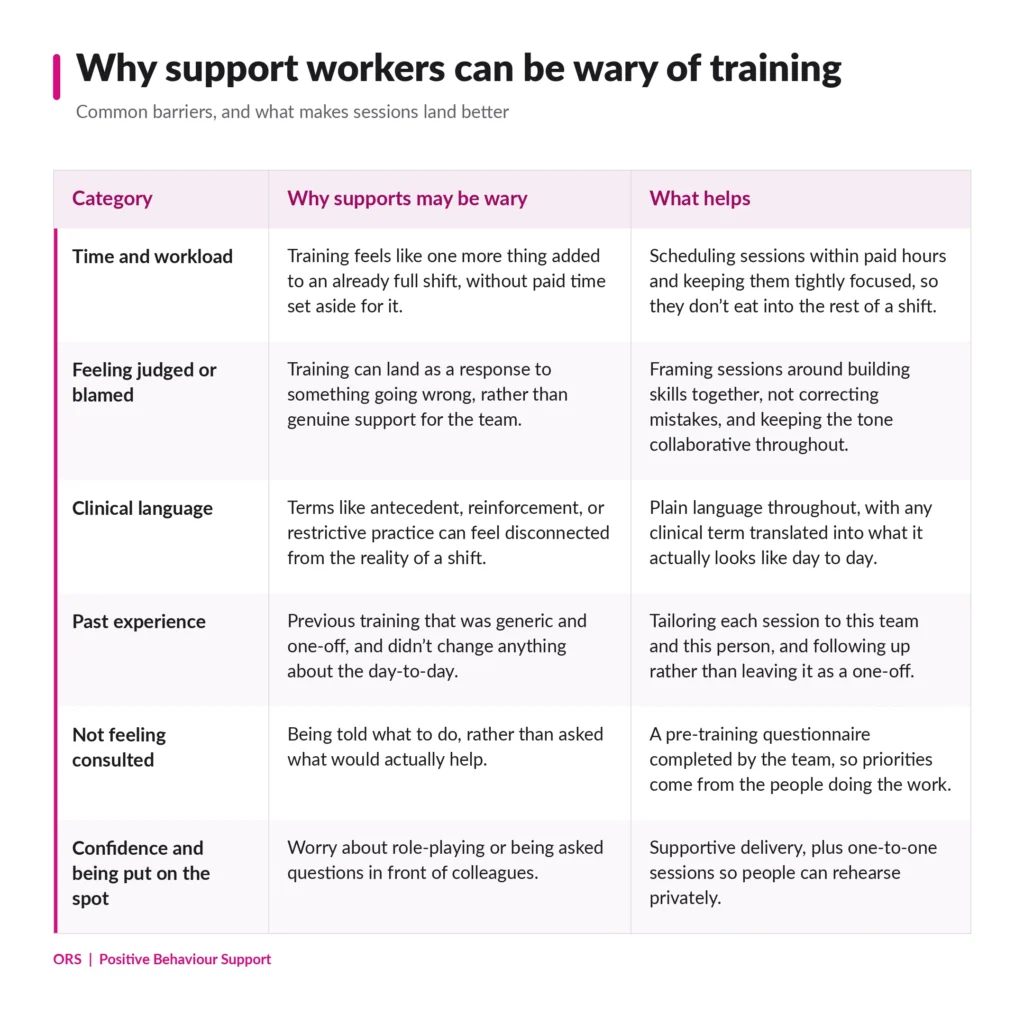
None of this means training should be watered down. It means it has to be designed with the support team’s real day in mind, not just the plan’s requirements.
How We Approach Training at ORS
Every training program starts before the first session is booked. We send a pre-training questionnaire, often completed by the team leader or house leader, so we understand the team’s needs and can prioritise accordingly rather than guessing.
- Risk and safety come first: if there’s been an increase in behaviours of concern or incidents, or an unauthorised restrictive practice has required a response, that’s where training starts, ahead of anything else on the list.
- Every session is tailored: to the specific needs of that support team, not a generic program delivered the same way for every group.
- We build understanding of the person, not just the plan: supports leave with a better understanding of the person’s presentation, needs, and diagnosis, not only a list of strategies to follow.
- We aim to make the job easier, not harder: training is designed around the support worker’s actual day, not only the plan’s requirements on paper.
- Sessions build one focus at a time: rather than trying to cover an entire plan in one sitting, in the same way we wouldn’t ask someone to work on fifteen new skills in a single session.
The goal is for positive behaviour support to become part of how a team already works: folded into everyday practice, not carved out as separate homework. Training that feels like an add-on rarely sticks. Training that fits naturally into a shift does.
Training That’s Practical, Not a Lecture
Traditional, lecture-style staff training has generally not proven effective for teaching hands-on skills. Behaviour skills training is the evidence-based alternative (Parsons et al., 2012), and it has four parts, used in every session:
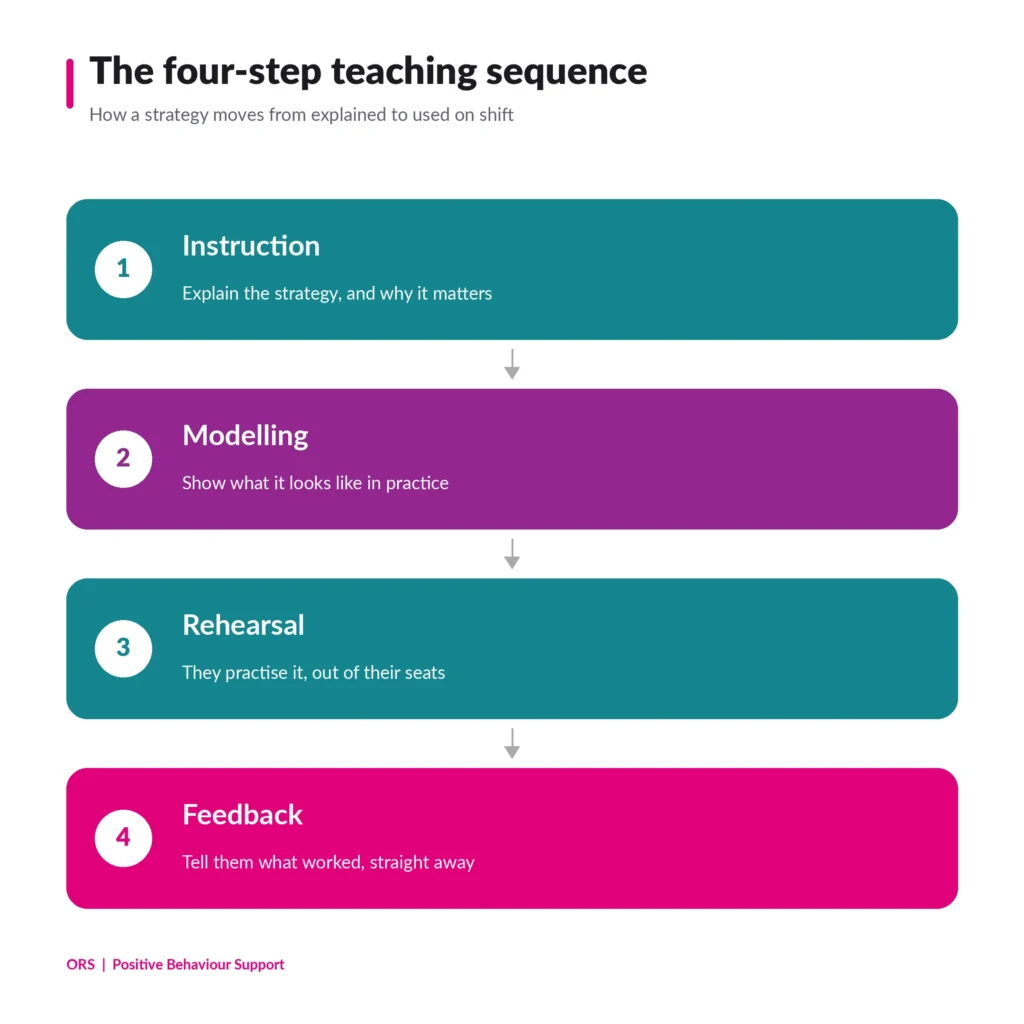
In a stakeholder session, this means building in practice time rather than talking for the full hour: explaining the strategy and why it matters, modelling it, having staff role play it while a practitioner watches, and giving feedback immediately. Role play can feel uncomfortable, but it’s where the learning actually happens, especially when it’s anchored to something real, like an incident the team has already experienced.
Both formats follow the same behaviour skills training principles above. Here’s how they differ in practice:
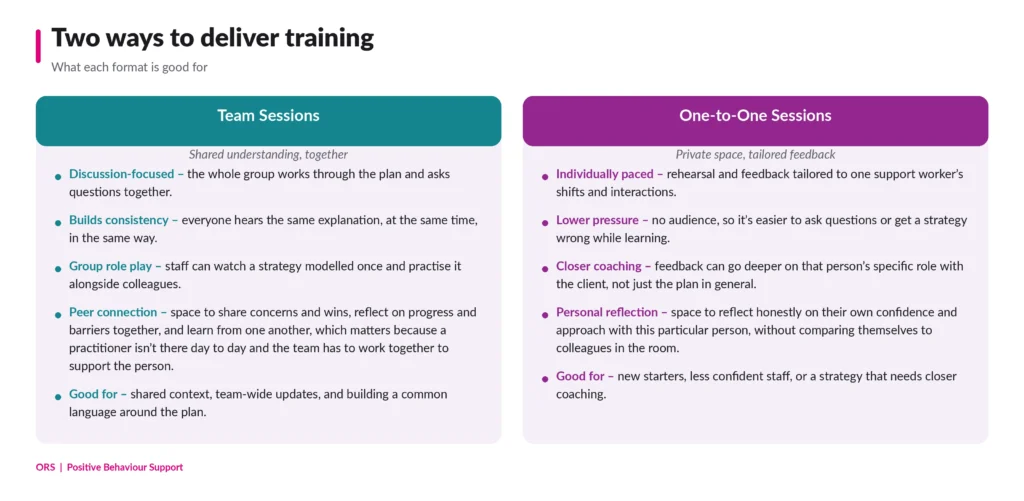
Most teams benefit from both rather than choosing one. A team session builds shared understanding and consistency across the group, while one-to-one sessions catch what a group setting can’t: the individual questions, hesitations, and shift-specific realities that rarely come up in front of colleagues.
Why the Follow-Up Session Matters as Much as the First
Skills fade without coaching. A single training session, delivered once and never repeated, rarely changes practice in a lasting way. A follow-up session gives everyone the chance to see what’s actually being implemented, and it signals that training was never a one-off obligation. A simple structure works well: check in, recap what was covered, and talk honestly about what’s working and what still needs to change.
Starting with what’s working matters too. Staff rarely notice their own incremental progress day to day, and hearing that their consistency has produced a measurable change is often what keeps people engaged with a plan long-term.
What This Means for You
If you’re a family member, carer, or referrer, this is what to expect and what to ask for: training that’s specific to the plan and the person, built around what your team has actually said they need, delivered with real practice rather than a lecture, and followed up rather than left as a one-off session. If a plan has been handed over without any of this, that’s worth raising. Training is not an add-on to positive behaviour support. It’s the part that decides whether the plan changes anything at all.
Frequently Asked Questions
What is stakeholder training in positive behaviour support?
It’s the training a behaviour support practitioner delivers to the people implementing a plan day to day, including support workers, family, and carers. The NDIS Commission’s Positive Behaviour Support Capability Framework (NDIS Quality and Safeguards Commission, 2024) expects practitioners to train implementers, adapt strategies to different environments, provide feedback on implementation, and offer ongoing training and supervision.
Can NDIS funding be used for stakeholder training?
Often, yes. Funded supports can include training and monitoring staff who are using a behaviour support plan, and positive behaviour support training for a family member, friend, or carer. What’s funded in an individual case still depends on the person’s plan and NDIS funding criteria.
How does ORS decide what to focus on in training?
It starts with a pre-training questionnaire, usually completed by the team leader or house leader, so priorities come from the team itself rather than guesswork. Risk and safety are prioritised first, particularly if there’s been an increase in behaviours of concern or incidents, or an unauthorised restrictive practice has needed a response. From there, sessions are tailored to that specific team and person.
How do support workers and families get more out of training?
Engagement usually improves when the session addresses concerns the team has actually raised, includes interactive practice rather than a lecture, and connects strategies to real incidents the team has experienced. It also helps when there’s a follow-up session booked in from the start, so training doesn’t feel like a one-off.
Refer to Us. If you’re supporting someone whose plan needs a team trained to implement it consistently, our positive behaviour support team works with participants, families, carers, providers, and support coordinators across Australia. Referrals and enquiries are welcome.
Work with Us. If this is how you’d like to practise, serious about training the people doing the day-to-day work and not just writing the plan, you’d fit in well here. Read about becoming a behaviour support practitioner or explore careers at ORS.
References
NDIS Quality and Safeguards Commission. (2024). Positive behaviour support capability framework: For NDIS providers and behaviour support practitioners (Version 3). https://www.ndiscommission.gov.au/sites/default/files/2024-07/Positive%20Behaviour%20Support%20Capability%20Framework%20Version%203.pdf
Parsons, M. B., Rollyson, J. H., & Reid, D. H. (2012). Evidence-based staff training: A guide for practitioners. Behavior Analysis in Practice, 5(2), 2–11. https://doi.org/10.1007/BF03391819


