


TL;DR. A restrictive practice limits a person's rights or freedom of movement, so the goal in positive behaviour support is always to reduce and eliminate it as quickly and safely as possible. That goal depends on data. Good restrictive practice data shows whether your proactive strategies are working, whether the practice is being used exactly as authorised (including at the right point in the escalation cycle), and whether it is still genuinely needed. This article covers why that data matters, the common barriers to collecting it, what to record for each type of restrictive practice, a simple collection process, and how it all feeds plan updates and fade-out.
Restrictive practices are among the most sensitive parts of positive behaviour support. Under the NDIS (Restrictive Practices and Behaviour Support) Rules 2018, a restrictive practice is any practice or intervention that “restricts the rights or freedom of movement of a person with disability”, and the regulated types are chemical, environmental, physical and mechanical restraint, and seclusion – each defined in detail in the NDIS Commission’s Regulated Restrictive Practices Guide. The framework around them is clear: under the National Framework for Reducing and Eliminating the Use of Restrictive Practices, they must be reduced and eliminated as soon as it is safe to do so. You cannot do that well without data.
This article is the practical companion to that principle. It is the second part of a series on data in PBS, following the piece on functional behaviour assessment.
Why does data matter so much for restrictive practices?
Positive behaviour support is a science, and every decision about a restrictive practice should be grounded in evidence. Whether a practice is necessary, when to fade it and how to fade it are all data questions, not matters of opinion. A few domains matter most here:
- Intervention selection: Are the proactive strategies actually supporting reduction of the restrictive practice? If not, why, and what needs to change?
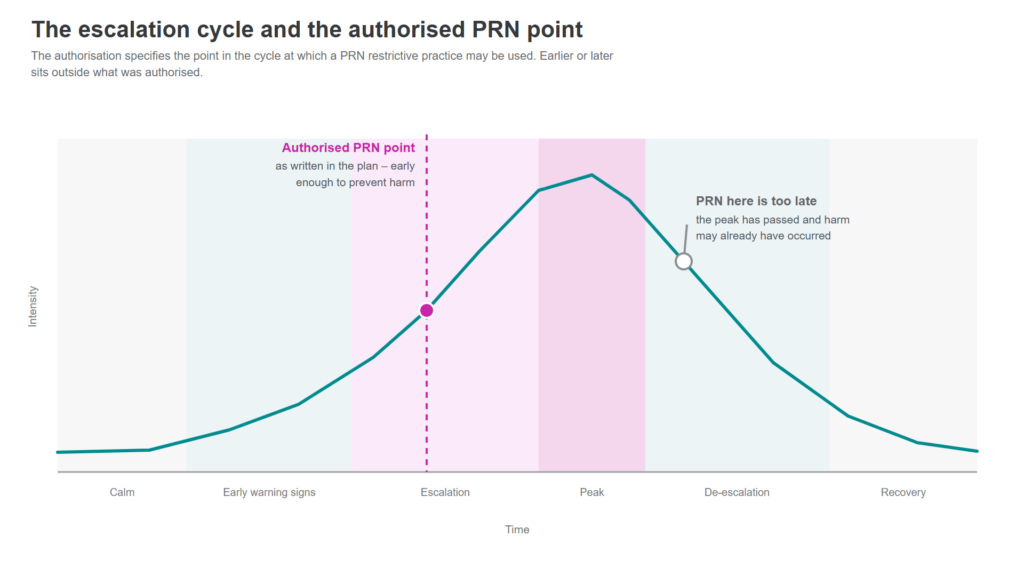
- Risk management: Is the practice used at the right time, as authorised in the behaviour support plan? A PRN (as-needed) medication given after a peak, once harm has already occurred, is a very different thing from one given early enough to prevent it.
- Ethical practice: Restrictive practices can and do limit human rights. The aim is to fade and eliminate them as quickly and safely as possible, and not actively working towards that can itself become an ethical breach.
- Accountability: Can everyone show what was done, why, and that it was in line with the plan and with legal and ethical requirements? That applies to the people implementing the plan as much as to the practitioner.
- Clinical reasoning: Is the practice still the least restrictive option, and does it reduce harm more than it creates risk? This is what justifies why a restrictive practice is still needed twelve, twenty-four or forty-eight months on.
- Fidelity and outcomes: Was the practice used as authorised, consistently across staff, and is it actually reducing harm?
There is an uncomfortable truth worth naming. When a restrictive practice has been in place for years without changing, the reason often is not that it is genuinely still required. It is that monitoring and data have been too weak to justify a fade-out, or the proactive strategies were never adjusted enough to make one possible.
Common barriers to good restrictive practice data
Restrictive practice data usually fails not because anyone stops caring, but because the systems around it are unclear, inconsistent or unused. Data that is subjective, fragmented, delayed or never reviewed cannot support safe practice, ethical decisions or fade-out. The barriers that show up most often are:
- Inconsistent data sources: The information is scattered across incident reports, progress notes, handover notes, QR codes and old data sheets, each with a different level of detail.
- Incomplete documentation: The crucial details go missing: the point in the escalation cycle, which less restrictive strategies were tried first, the evidence behind the decision to use the practice, and how the person responded.
- Delayed recording: Notes written days or weeks later rely on memory.
- Variation between staff: Differences in training and understanding lead to inconsistent recording and inconsistent use.
The thread running through all of these is quality over volume. A pile of data that does not answer your clinical question is overload, not insight.
How to get better data from staff and stakeholders
The goal is better documentation, not more of it. A few practical moves make the biggest difference.
Be explicit about exactly what you need, and redesign the tools around it. Keep it simple. A short, tick-box data sheet with one or two well-chosen questions (“did you use redirection, and at what point?”) often produces better data, with less work for staff, than a long narrative form.
Explain how the data will be used and why it matters. Support workers are far more likely to record well when they understand that their notes are not just paperwork, but the very thing that lets you change the plan. Close the loop by showing them the change their data drove.
Address the fear directly. For many newer support workers, restrictive practices carry a sense of doing something wrong. It helps to be clear that a restrictive practice is not a dirty word, that when it is authorised and used as written in the plan they are not in trouble, and that honestly reporting what they actually did is exactly what allows the practice to be improved or reduced.
Work with language and cultural barriers rather than around them, using interpreters in training, translated or visual data sheets, or a switch to simple anecdotal collection. Make collection feasible within the shift, since support workers are only paid for the time they are there. And when it still does not work, seek supervision, document your efforts and barriers in the behaviour support plan, raise them at panel, and escalate through your senior team, reporting to the NDIS Commission where that is required.
What to record for each type of restrictive practice
For any PRN restrictive practice, one question matters above all others: at what point in the escalation cycle was it used? The authorisation specifies that point, so using a practice earlier or later sits outside what was authorised. Patterns in this data tell you whether to bring the practice in earlier, hold it later, or trial least restrictive alternatives first. As a matter of good practice, physical restraint and seclusion are reserved for PRN use, not routine use.
Below are the different types of restrictive practices. Each dot point explains what information must be recorded when that practice is used.
- Physical restraint (PRN) – The behaviour leading to it, what was tried first and for how long, the point in the escalation cycle, duration, onset and intensity, the de-escalation outcome, any injury and recovery time, and the participant's response afterwards, including any required post-incident monitoring or health review.
- Seclusion (PRN) – The behaviour leading to it, the point in the escalation cycle, the exact duration, the participant's behaviour during seclusion with continuous monitoring and regular safety checks, the time to return to baseline, and the response afterwards.
- Chemical restraint (routine or PRN) – For routine use, the conditions for use, monitoring requirements and side effects. For PRN, the behaviour, strategies tried first, point in the cycle, time administered, time to take effect, response and side effects.
- Environmental restraint (routine or PRN) – For routine use, the type of restriction and the frequency of access attempts. For PRN, the trigger, behaviour, strategies tried first, point in the cycle and outcome.
- Mechanical restraint (routine or PRN) – For routine use, the device, when and why it is used, duration and baseline. For PRN, the behaviour prompting use, what the use looked like, the point in the cycle, any attempts to remove the device, distress observed and the outcome with safety considerations before and after.
The environmental example shows why this detail matters. If a cupboard or door is locked, it is still worth recording how often the person tries to access it. Frequent checking suggests the restriction is still doing something and a fade-out is premature. If they rarely or never check, that is data pointing towards a trial of fading it out.
A simple restrictive practice data process
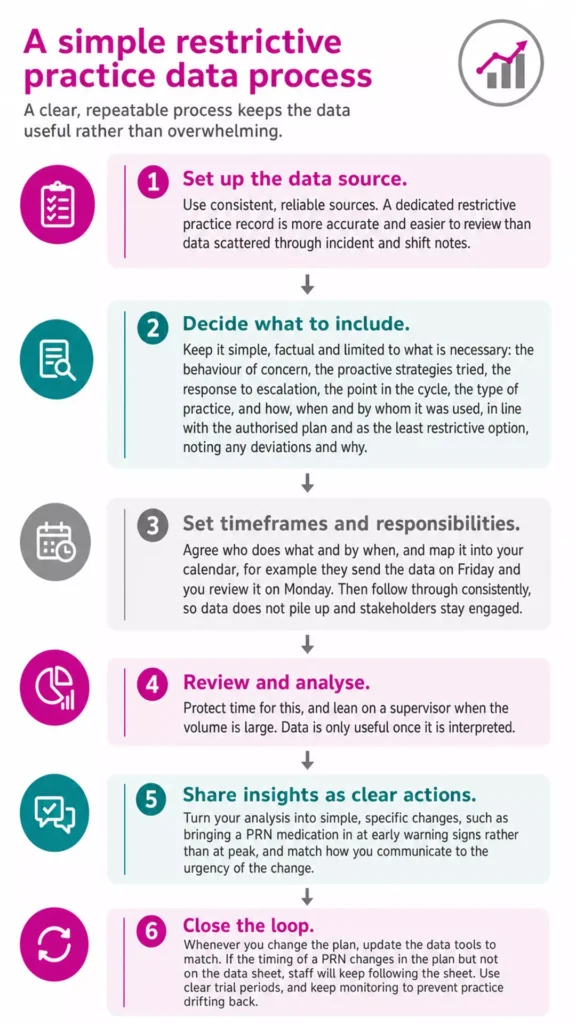
A clear, repeatable process keeps the data useful rather than overwhelming.
- Set up the data source: Use consistent, reliable sources. A dedicated restrictive practice record is more accurate and easier to review than data scattered through incident and shift notes.
- Decide what to include: Keep it simple, factual and limited to what is necessary: the behaviour of concern, the proactive strategies tried, the response to escalation, the point in the cycle, the type of practice, and how, when and by whom it was used, in line with the authorised plan and as the least restrictive option, noting any deviations and why.
- Set timeframes and responsibilities: Agree who does what and by when, and map it into your calendar, for example, they send the data on Friday and you review it on Monday. Then follow through consistently, so data does not pile up and stakeholders stay engaged.
- Review and analyse: Protect time for this, and lean on a supervisor when the volume is large. Data is only useful once it is interpreted.
- Share insights as clear actions: Turn your analysis into simple, specific changes, such as bringing a PRN medication in at early warning signs rather than at peak, and match how you communicate to the urgency of the change.
- Close the loop: Whenever you change the plan, update the data tools to match. If the timing of a PRN changes in the plan but not on the data sheet, staff will keep following the sheet. Use clear trial periods, and keep monitoring to prevent practice drifting back.
Turning the data into plan updates and fade-out
Data is what justifies whether a restrictive practice is still needed, and what drives its reduction. When you update the comprehensive behaviour support plan, that data should flow through all the relevant sections: the functional behaviour assessment and data-collection strategies, the escalation table, the response and restrictive practice tables, frequency and duration, the proactive and reactive strategies, and the rationale.
Both proactive and reactive strategies need to justify the fade-out, so you should be able to name the specific proactive strategies tied to reducing each restrictive practice. Which skills are you building, which environmental changes are you making, and how are you increasing the person's tolerance? When a person can use a target skill independently, the case for reducing or eliminating the practice becomes clear and evidence-based.
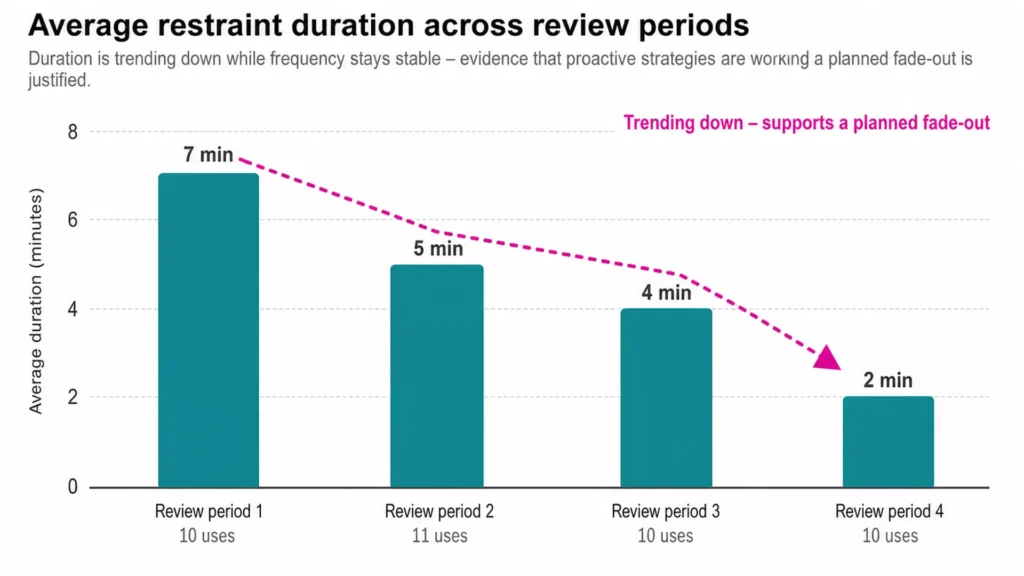
Visualising the data helps you tell that story. Charting an average duration over time can show movement towards fade-out even when frequency is unchanged. To use a simple illustration, a restraint that averaged seven minutes in one review period and five in the next is trending down, which supports a planned reduction. Charting behaviour against medication changes can likewise justify a down-titration. Fade-out trials work best when the stages and criteria are explicit, for example, a set number of successful days at one stage before moving to the next, with progression made openly contingent on receiving sufficient data from stakeholders.
Better data, fewer restrictions
Restrictive practices must be reduced and eliminated as quickly and safely as possible, and data is how you justify, monitor and achieve that. The aim is always better documentation, not more of it. And when you are not sure whether your data, your timing or your fade-out plan is right, seek supervision. It is the fastest route to safer, more confident practice.
Refer to ORS. If you are supporting someone who is subject to restrictive practices and want them monitored, reduced and faded out safely, our positive behaviour support team works with participants, families and support coordinators across Australia. Referrals and enquiries are welcome.
Work with us. If this is how you like to practise; rigorous about data, serious about reducing restrictions, you would fit in well here! submit your quick application below!
Frequently asked questions
What is a restrictive practice?
A restrictive practice is any intervention that restricts the rights or freedom of movement of a person with disability. The recognised types are chemical, environmental, physical and mechanical restraint, and seclusion. Under the positive behaviour support framework, they must be reduced and eliminated as soon as it is safe to do so.
What are the main types of restrictive practices?
There are five: chemical restraint, environmental restraint, physical restraint, mechanical restraint and seclusion. Each requires its own data, but all share one essential question for as-needed use, which is the point in the escalation cycle at which the practice was used.
Why is data collection important for restrictive practices?
Data shows whether a restrictive practice is still needed, whether it is being used exactly as authorised, and whether proactive strategies are working to reduce it. It underpins the legal and ethical duty to fade and eliminate restrictive practices as quickly and safely as possible.
For a PRN restrictive practice, what is the single most important thing to record?
The point in the escalation cycle at which it was used. The authorisation specifies that point, so this is what shows whether the practice was used as authorised, and patterns in it guide whether to adjust the timing or trial less restrictive alternatives first.
How does data support fading out a restrictive practice?
It demonstrates that the proactive strategies and new skills are working, and it reveals trends in frequency and duration over time. That evidence justifies a planned reduction in the behaviour support plan and shows, clearly, when a practice can be safely reduced or removed.


