


TL; DR. Positive behaviour support is not a standalone treatment for a substance use disorder, and trying to make it one sets everyone up to fail. Substance use disorders need specialised, evidence-based care such as medical treatment, drug and alcohol counselling and relapse prevention. The PBS role is to understand the function of the behaviour, reduce harm, protect the dignity of risk, use a motivational rather than confrontational approach, and work as part of a care team alongside drug and alcohol services. The shift that helps most is moving from “make the substance use stop” to “what is this behaviour doing for this person, and how do we reduce harm safely?”
PBS referrals are becoming more complex. Alongside behaviours of concern, practitioners increasingly support participants with a mental health diagnosis and a history of substance use. Families and support providers often want the substance use to stop, and the pressure can land squarely on the behaviour support practitioner. That pressure can quietly push us outside our scope.
This article sets out how PBS can add genuine value in this space, where its limits sit, and how to work effectively when substance use is part of the picture.
Where does PBS fit when a participant uses substances?
Start with a clear statement of scope. Positive behaviour support is not considered a primary or standalone treatment for drug and alcohol problems. Substance use disorders are complex and usually require specialised, evidence-based interventions: medical treatment such as supervised detoxification and pharmacotherapy, drug and alcohol counselling, cognitive behavioural therapy, motivational interviewing, psychotherapy and relapse prevention.
That does not mean PBS has no role. It means PBS is one part of a wider response. Practitioners bring functional behaviour expertise, support consistent implementation, and help the people around the participant respond well. Working under the Positive Behaviour Support Capability Framework, more advanced practice involves leading clinical direction and collaborating across different knowledge bases, and substance use is exactly the kind of area where that collaboration matters.
The risk to watch for is the service gap. Mental health services sometimes decline to treat until substance use stops, while drug and alcohol services sometimes decline until mental health is addressed. Some specialist services do not feel equipped for people with disabilities, and some will step back once NDIS funding is in place. When that happens, the expectation can drift onto PBS to do work it is not funded or trained to do. The answer is not to absorb that work. It is to advocate, with the support coordinator, to bring the right services to the table.
Is substance use a behaviour of concern? A reframe
Stakeholders often frame substance use as a behaviour of concern that PBS should eliminate. The participant frequently does not share that goal. Pushing cessation onto someone who has not chosen it tends to produce resistance, not change.
A functional assessment offers a more useful frame. Like any behaviour, substance use serves a purpose. For many people, it is connected to trauma, to managing pain, to calming anxiety, or to social connection. Understanding what the substance use is doing for a particular person lets us step out of the emotive “drugs are bad” narrative and ask a better question: how can this person meet that need in a way that carries less harm?
It also helps to hold the current clinical understanding of addiction. Dependence is understood as a health condition, not a failure of willpower or character. Reading that frustration into a plan, or treating use as a moral failing, gets in the way of good support.
What harm minimisation actually means (and what it doesn’t)
Harm minimisation is the principle that has underpinned Australia's National Drug Strategy for decades. The Department of Health describes it through three pillars: demand reduction, supply reduction and harm reduction. In day-to-day PBS practice, the relevant pillar is usually harm reduction, which involves reducing the risks and harms associated with use, rather than insisting on immediate and total cessation.
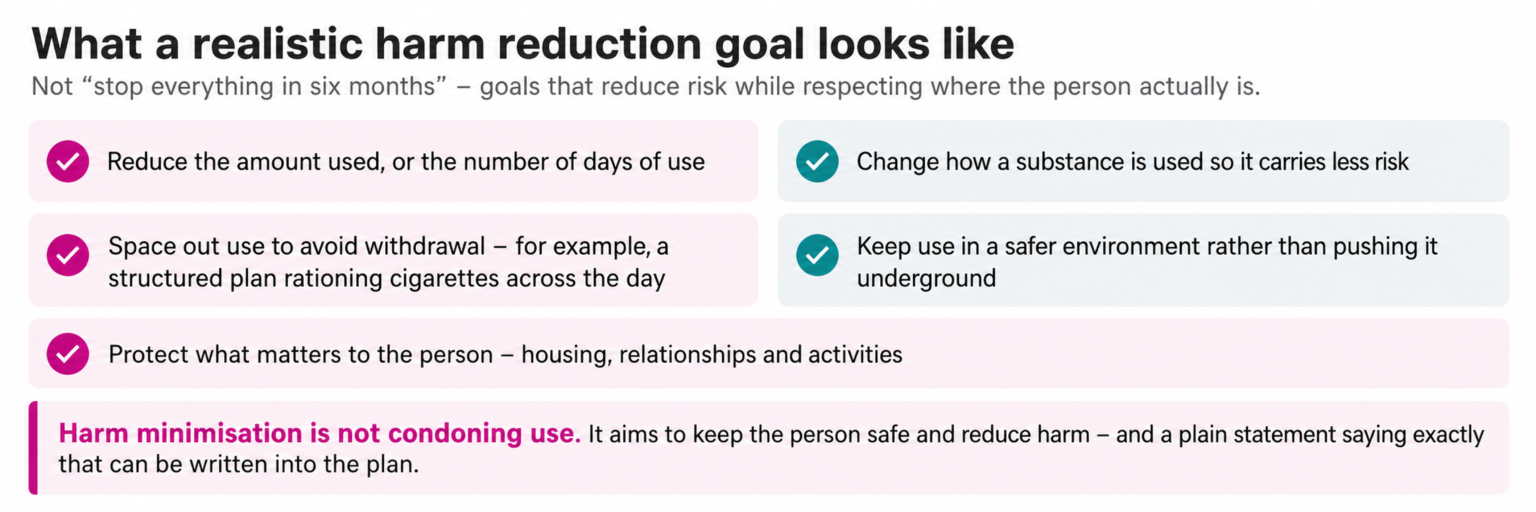
This is where plans often go wrong. A goal to cease four or five substances within six months, for someone with heavy, dependent use, is usually unachievable. It sets the participant up to fail and the practitioner up to chase an impossible target. More realistic goals tend to work backwards. A person might stop one substance while continuing another, then build from there. A practical harm reduction goal might focus on:
- Reducing the amount used, or the number of days of use.
- Changing how a substance is used so it carries less risk.
- Spacing out use to avoid periods of withdrawal, for example, a structured plan that rations cigarettes across the day.
- Keeping use in a safer environment rather than pushing it underground.
- Protecting the things that matter to the person, such as their housing, relationships and activities.
Harm minimisation is not the same as condoning or encouraging use, and clinicians sometimes feel uncomfortable here, as though a goal that is not “stop” means they are endorsing the behaviour. It can help to write a plain statement into the plan explaining that harm minimisation aims to keep the person safe and reduce harm, and does not condone substance use. If you are unsure how to frame harm reduction strategies, a drug and alcohol service is the right partner to consult.
Dignity of risk and avoiding unnecessary restrictive practices
Dignity of risk is the principle that people have the right to take reasonable risks and to live with autonomy and self-determination. Overprotecting someone to remove all risk can quietly diminish their quality of life, independence and growth. We all take calculated risks as part of living.
A useful test when a team is anxious about a participant's substance use is to ask: if this person did not have a disability, and they were an adult choosing to have a drink with friends, would we treat it as a problem to be controlled? Often, the honest answer is no.
This matters because substance use is a common point where support teams reach for control. Limiting someone's finances, supervising or stopping outings, or removing alcohol can all stray into restrictive practice. Restrictive practices sit within a strict regulatory and authorisation framework, and a hard line often backfires. It can push use into less safe settings, increase secrecy and shame, and intensify the very behaviour everyone wants to reduce. The more effective path is usually to sit with reasonable risk, build proactive strategies, plan for safety, and explore what the person gets from the behaviour so it can be met another way.
Motivational interviewing: working with ambivalence
Motivational interviewing is a counselling approach suited to situations where there is resistance, denial or limited awareness of a problem. It differs from a solution-focused approach in how it engages.
Rather than confronting the substance use head-on, the practitioner explores the impact of it and helps the person notice the discrepancy between what they say they want and what their behaviour is doing. Most people sit in ambivalence, somewhere around half wanting to change and half not. Gently and repeatedly reflecting that gap, without judgement, lets the balance tip in the person's own mind until they can articulate a clearer goal. The person leads. Sometimes the thing that finally motivates change has nothing to do with what everyone else sees as the problem, and everything to do with what the person values, such as the cost of a habit or its effect on a relationship.
Why does the whole system have to be on board?
Substance use affects the system around the person, not just the person. Families and support teams often respond with control, judgement or pressure, which tends to produce shame, and shame tends to intensify use. Shifting that dynamic is often the real work.
This is why a care team or multi-systemic approach matters. If the practitioner runs a careful motivational approach while support workers lecture, shame or police the participant day to day, the two cancel out, and the person stays stuck in ambivalence. A care team is more than a stakeholder meeting. It is a group, potentially including the participant, family, support workers, health professionals, the support coordinator and specialist services, working collaboratively towards a shared plan. Training the people who are with the participant the most, so they reflect the same approach, is often the single biggest lever for change.
A safety point belongs here. Withdrawal from some substances is dangerous, and alcohol withdrawal in particular can be life-threatening and needs medical supervision. Where there is dependent use and any plan to reduce it, a drug and alcohol service and the participant's medical team should be involved, with support coordination helping to bring them in. Those services also hold the detox, rehabilitation and relapse-prevention pathways that sit outside the PBS role.
A simple formulation tool: the five Ps
When a case feels overwhelming, a five Ps formulation can bring order to it. It is a way of organising what is going on before deciding what is reasonable and where PBS fits.
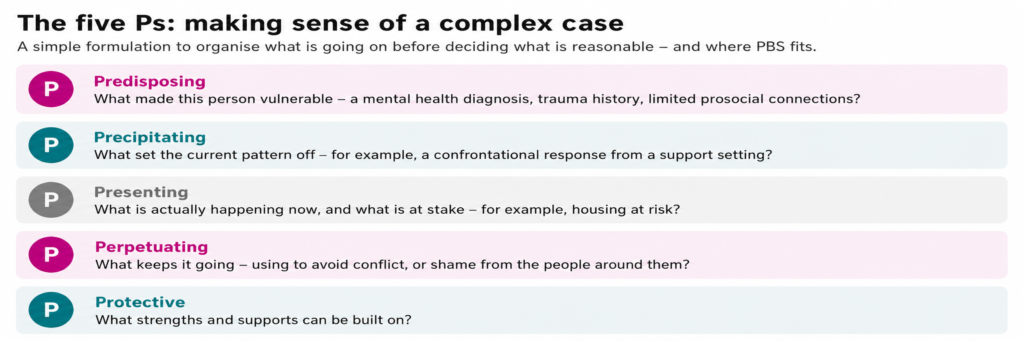
From there, the practitioner can name a realistic goal, describe in one plain sentence how they would manage the situation, and be clear about what sits inside and outside the scope of PBS.
The shift that makes the difference
Across all of this, one shift does the heavy lifting. Move from “the substance use must stop” to “this behaviour is serving a function, so how do we reduce harm, protect dignity and bring in the right help?” PBS adds real value when it stays in its lane: understanding behaviour, reducing harm, supporting the team, and collaborating with the services that treat substance use. That is not PBS failing to be the whole answer. That is PBS being one strong, clear part of it.
This article covers a sensitive topic. If you, a participant or a family you work with needs support, the National Alcohol and Other Drug Hotline offers free, confidential advice 24 hours a day on 1800 250 015.
Refer to ORS. If you are supporting someone whose behaviour support needs intersect with mental health or substance use, our positive behaviour support team works as part of the care team, alongside drug and alcohol and health services, with participants, families and support coordinators across Australia. Referrals and enquiries are welcome.
Work with us. If this is how you like to practise – clear about scope, compassionate about people and serious about harm reduction – you would fit in well here. Read about becoming a behaviour support practitioner or submit a quick 1 minute application below.
Frequently Asked Questions
Is substance use a behaviour of concern that PBS should fix?
Not in the sense of eliminating, it is on the family's behalf. Substance use often serves a function, and the participant may not share a cessation goal. PBS can assess that function, support harm reduction, and work with the team, but a substance use disorder needs specialised treatment beyond PBS.
Can a PBS practitioner treat a substance use disorder?
It is reducing the harms linked to substance use rather than demanding immediate, total cessation. It is the long-standing basis of Australia's National Drug Strategy, which balances demand reduction, supply reduction and harm reduction.
What is harm minimisation in simple terms?
It is reducing the harms linked to substance use rather than demanding immediate, total cessation. It is the long-standing basis of Australia's National Drug Strategy, which balances demand reduction, supply reduction and harm reduction.
Does harm minimisation mean condoning drug use?
No. It aims to keep a person safe and reduce harm while respecting their autonomy. Many plans benefit from a plain statement that explains harm minimisation does not condone use, which helps everyone feel more comfortable with the approach.
When should we involve a drug and alcohol service?
Early, and especially where there is dependent use, withdrawal risk or a plan to reduce use. Alcohol withdrawal can be life-threatening and needs medical supervision. Drug and alcohol services hold the detox, rehabilitation and relapse-prevention pathways, and support coordination can help bring them to the table.


