


TL;DR. Restrictive and repetitive behaviours (RRBs) are a core diagnostic feature of autism. RRBs also appear in Fragile X syndrome, Rett's syndrome, OCD, Tourette syndrome and Parkinson's disease, but our focus here is autism, the most common primary disability among NDIS participants nationally, at around 35% of the Scheme (NDIS, 2023). Either way, we see RRBs constantly in practice, and we never treat the presence of an RRB, on its own, as a behaviour of concern. In PBS, we separate other people's discomfort from genuine risk of harm, we run a proper functional behaviour assessment before recommending any change, we protect a person's right to stim and to withdraw consent, and we build skills rather than default to masking. Culture, communication style, and the principle of using the least restrictive option all shape the plans we write.
Whether you're a parent, a carer, or studying towards a career in this field, this article is written as a plain-language walk-through of how we think about restrictive and repetitive behaviours at ORS: what they are, why treating them as something to eliminate can shade into ableism, how we work out whether one is genuinely a behaviour of concern, and what our interventions can look like once we understand the function. Throughout, we use identity-first language such as autistic person, which is broadly preferred by the autistic community, while recognising that individual preference always comes first: when we're not sure with a specific person, we default to person-first language (an individual with autism), and we always check directly.
Our approach is grounded in the social model of disability, not the medical model. The difference between the two runs through everything below.
A Few Terms Worth Pinning Down
Before going further, a handful of terms come up constantly in this space and are worth having a shared definition for:
| Term | What it means |
|---|---|
| Stimming | Self-stimulatory behaviour. |
| Stereotypy | Persistent repetition of a behaviour. |
| Assent | Agreement or approval, given through verbal or non-verbal communication. |
| Neurodiverse | Someone who thinks, learns or acts differently to neurotypical people. There is no single “right” way to think, learn or act; differences are a divergence, not a deficit. |
| Neurotypical | Someone who thinks, learns or acts in ways considered typical within their culture and for their age group. |
Two Subtypes We Watch For
Research generally converges on two main subtypes of RRB (Boyd et al., 2012; Keating et al., 2023), though some studies propose a third, separate subtype involving fixated interests, preoccupations and attachments (Honey et al., 2008).
| Subtype | What it looks like | What the research suggests |
|---|---|---|
| Repetitive sensory and motor behaviours | Stereotyped movements, repetitive manipulation of objects, repetitive self-injurious behaviour | Tends to remain stable or decrease across childhood; less evidence of a strong genetic pattern |
| Insistence on sameness | Compulsions, rituals, routines, rule-governed behaviour, specific or fixated interests | Tends to increase in severity over time; more evidence of running in families |
Some subtypes may have a genetic basis: insistence on sameness tends to run in families more than repetitive sensory and motor behaviours (Cannon et al., 2010; Szatmari et al., 2006). RSMB tends to stay stable or ease over childhood, while insistence on sameness can increase in severity (Kim & Lord, 2010; Richler et al., 2010). Co-occurring intellectual disability may also change the picture (Esbensen et al., 2009) — one more reason we assess the individual in front of us, not a generic rule.
Ableism and Masking: Medical Model vs Social Model
We hold onto one idea firmly here: a non-autistic person can never fully understand the emotional, sensory and physical experience of an autistic person. Historically, RRB intervention was used as a treatment lens through the medical model: teach masking, meaning hiding or camouflaging a person's natural behaviour so they appear more neurotypical. Stop the hand-flapping, quieten the vocalisations, make the behaviour disappear so the classroom, the family outing or the appointment looks more comfortable for everyone else. We don't think that approach is appropriate, and we've seen it cause real harm. Sometimes neurotypical clinicians or caregivers engage in abusive practices without recognising it (Lynch, 2019), which is exactly why we think this needs to be named directly rather than assumed away.
Masking all day, for instance holding it together through a mainstream classroom under an unspoken rule about how to behave, then coming home and crashing, has been linked to burnout, serious mental health difficulties and, in some cases, suicidality. That said, we don't think masking is always harmful. There can be moments where presenting in a particular way is genuinely adaptive, for instance while working toward a specific goal, provided the person also has spaces where they can let go and be unmasked, and is not doing so for such a large part of every day that it becomes exhausting.
We also find it useful to frame this for families who are, understandably, sometimes focused on how a behaviour looks to others. We ask ourselves what a constant, effortful performance of neurotypical behaviour actually buys a person. Research on the double empathy problem suggests autistic people often understand and empathise with other autistic people more readily than neurotypical people do, and many autistic adults, when asked, would rather be liked authentically by a smaller circle than liked by a much larger one while feeling like they are performing for it.
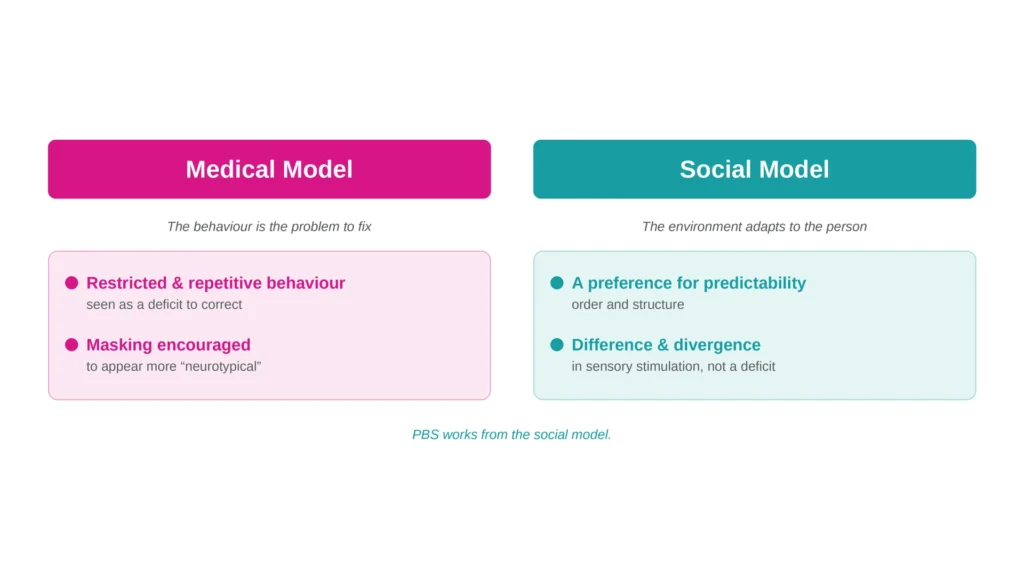
The distinction underneath all of this is the medical model of disability versus the social model, or neurodiversity paradigm (Mathur & Valerius, 2023). The medical model frames restricted and repetitive behaviour, interests or activities as the problem. The social model instead frames the same presentation as a preference for predictability, order and structure, and a difference or divergence in sensory stimulation, then asks what a workplace, school or family can adjust to support that. We work from the social model. We also try to educate families and other carers on how RRBs function positively for a person's wellbeing, and to model and teach acceptance of neurodiversity more broadly (Mathur et al., 2024).
Stimming: What Autistic Adults Actually Say
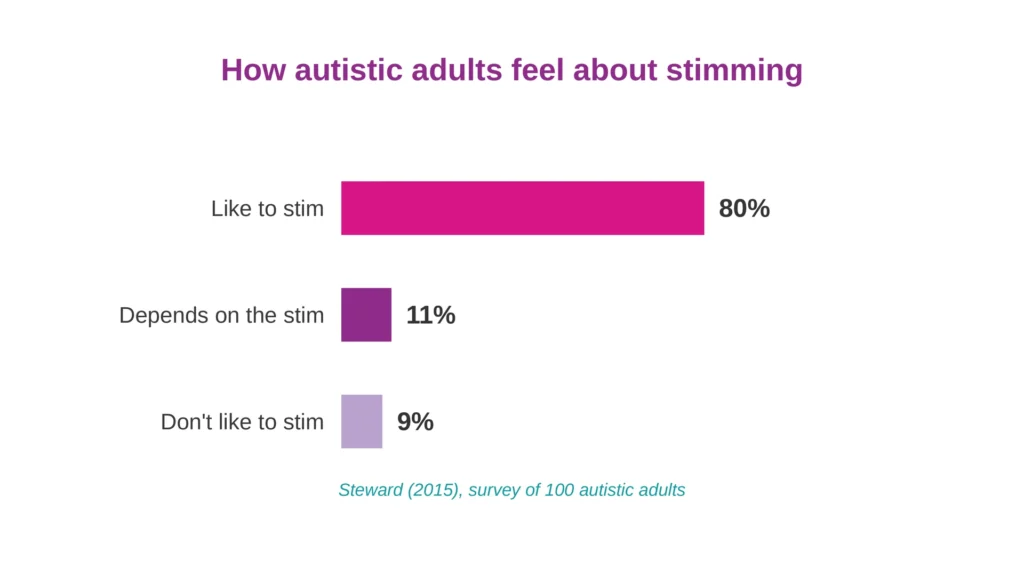
Self-stimulatory behaviour, or stimming, is one of the most common and most misunderstood RRBs. Kapp and colleagues (2019) found stimming is self-regulatory — it soothes intense emotions like anxiety or excitement — but is met with a persistent lack of social acceptance.
Most people, autistic or not, do something with their hands or feet when concentrating. What varies is severity, and how much stigma attaches to the form it takes.
When Does an RRB Cross the Line?
The first question we ask: is it seriously necessary to target this behaviour? We weigh up real risk of harm against something closer to other people's embarrassment. There's very little evidence RRBs interfere with learning — stimming can actually help people focus (Kapp et al., 2019) — and Cooper, Heron and Heward's (1987) nineteen considerations for reducing a behaviour never include “looks different to neurotypical peers.”`
| Worth exploring in more detail | Not necessarily a behaviour of concern |
|---|---|
|
|
Where a restrictive practice is genuinely required, we make sure it meets the five-P principles: least restrictive, shortest possible duration, last resort, and proportionate to the actual risk of harm.
We Put Assent First
Assent. Agreement or approval, given through verbal or non-verbal communication. Assent can be given, and withdrawn, by the person at any time — even if they have no verbal communication or very limited communication ability.
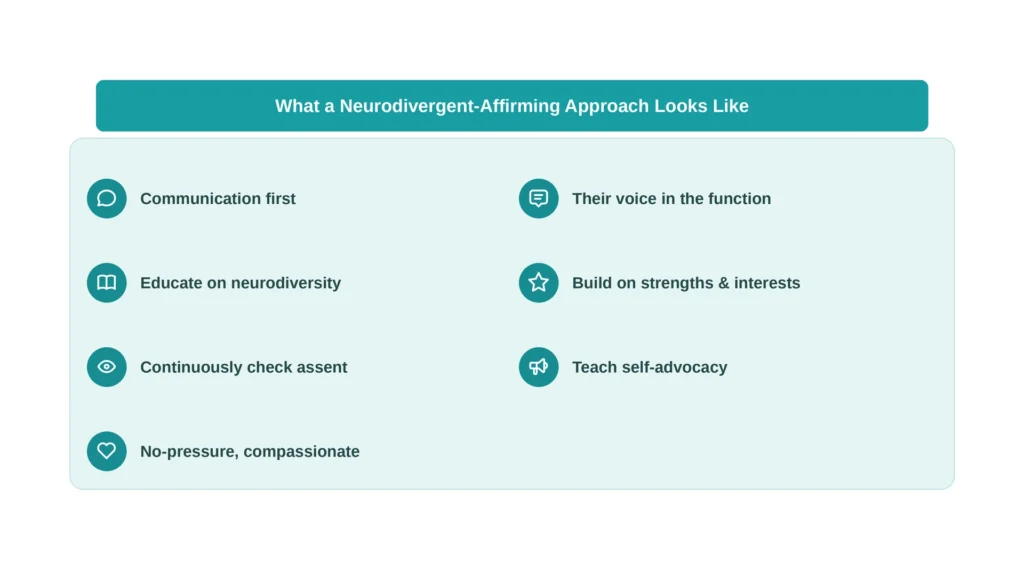
We pair every intervention with teaching supports how to recognise a person's assent, and its withdrawal, even where communication is minimal or non-verbal. Flinching, moving away or losing interest can all signal withdrawn assent — that's the moment we pause, rather than push through.
We also practise trauma-informed care: acknowledging trauma's impact, building trust, promoting genuine choice, and focusing on skills (Mathur et al., 2024) — rather than compliance training or escape extinction, which can be traumatising.
Culture Matters: We Practise With Humility
What counts as “restricted” or “repetitive” is itself socially subjective across cultures (Matson et al., 2017), and families may under-report an RRB if they see it as socially undesirable. We practise cultural humility by involving the family throughout the process, gathering their cultural values and preferences, and using an interpreter where needed.
What a Neurodivergent-Affirming Approach Looks Like
The Bottom Line
- We see an RRB as a normal, expected part of the autism presentation, not automatically a problem to solve
- We separate other people's discomfort from genuine risk of harm before deciding a behaviour is a concern
- We run a full functional behaviour assessment, in two parts: confirm it is genuinely a concern, then establish the function
- We always rule out a medical cause before assuming a behaviour is purely learned or sensory
- We build skills and use the person's own interests as the teaching tool, rather than defaulting to suppression or masking
- We honour consent and assent throughout, and keep culture and communication preference central to the plan
Refer to ORS. If you're supporting someone with restrictive or repetitive behaviours and want a proper functional behaviour assessment done well, our positive behaviour support team works with participants, families and support coordinators across Australia. Referrals and enquiries are welcome.
Work with us. If this is how you'd like to practise one day, curious, evidence-led and genuinely neurodivergent-affirming, you'd fit in well here. Read about becoming a behaviour support practitioner or submit a one minute quick-apply below.
Further Resources
A few external resources we point families and carers toward for accessible, practical reading on stimming and neuro-affirming practice:
Frequently Asked Questions
Are restrictive and repetitive behaviours always a problem to fix?
No. RRBs are part of the diagnostic presentation of autism and we don't treat them as automatically a behaviour of concern. We see the presence of an RRB as a prompt to assess actual risk and function, not as a reason for an automatic plan to reduce it.
What is masking, and why is it a concern?
Masking is hiding or camouflaging natural autistic behaviour to appear more neurotypical. Used occasionally and adaptively, it may not cause harm, but sustained masking, for instance holding it together all day at school, has been linked to burnout, mental health difficulties and, in some cases, suicidality.
What is stimming, and is it something to reduce?
Stimming is self-stimulatory behaviour that autistic adults describe as self-regulatory, helping to manage anxiety, excitement or uncertainty. Research suggests most autistic adults value their stims. We generally support it rather than suppress it, unless it is causing genuine harm.
How do you know if an RRB needs a full functional behaviour assessment?
We start by asking whether it is seriously necessary to target the behaviour at all. If there is a real question about risk of harm to the person or others, or a genuine impact on their ability to function safely, that is our signal to move into a full FBA covering both why it is a concern and what function it serves.
What do interventions for RRBs focus on?
Wherever possible, we focus on building communication, play, self-care and coping skills, using the person's own strengths and interests, rather than directly targeting the RRB for reduction. Directly suppressing an RRB can escalate into aggression or anxiety, so we treat that as a last resort, reserved for behaviours that carry a genuine risk of harm.
References
Boyd, B. A., McDonough, S. G., & Bodfish, J. W. (2012). Evidence-based behavioral interventions for repetitive behaviors in autism. Journal of Autism and Developmental Disorders, 42(6), 1236–1248.
Cooper, J. O., Heron, T. E., & Heward, W. L. (1987). Applied behavior analysis. Merrill.
Diagnostic and Statistical Manual of Mental Disorders (5th ed., text rev.). (2022). American Psychiatric Association.
Kapp, S. K., Steward, R., Crane, L., Elliott, D., Elphick, C., Pellicano, E., & Russell, G. (2019). “People should be allowed to do what they like”: Autistic adults’ views and experiences of stimming. Autism, 23(7), 1782–1792.
Keating, J., Van Goozen, S., Uljarevic, M., Hay, D., & Leekam, S. R. (2023). Restricted and repetitive behaviors and their developmental and demographic correlates in 4-8-year-old children: A transdiagnostic approach. Frontiers in Behavioral Neuroscience, 17, 1085404.
Lynch, C. L. (2019). Invisible abuse: ABA and the things only autistic people can see. NeuroClastic.
Mathur, S., Renz, E., & Tarbox, J. (2024). Affirming neurodiversity within applied behavior analysis. Behavior Analysis in Practice, 17.
Mathur, S. K., & Valerius, A. P. (2023). Understanding the lived experiences of autistic adults. Peter Lang.
Matson, J. L., Matheis, M., Burns, C. O., Esposito, G., Venuti, P., Pisula, E., Misiak, A., Kalyva, E., Tsakiris, V., Kamio, Y., Ishitobi, M., & Goldin, R. L. (2017). Examining cross-cultural differences in autism spectrum disorder: A multinational comparison from Greece, Italy, Japan, Poland, and the United States. European Psychiatry, 42, 70–76.
National Disability Insurance Agency. (2023). Participant Dashboard updates: Autism. NDIS. https://www.ndis.gov.au/news/9601-participant-dashboard-updates
Steward, R. L. (2015). Repetitive stereotyped behaviour or ‘stimming’: An online survey of 100 people on the autism spectrum. Paper presented at the 2015 International Meeting for Autism Research.
Additional studies on genetic patterns and developmental trajectories of RRB subtypes (Cannon et al., 2010; Cuccaro et al., 2003; Esbensen et al., 2009; Honey et al., 2008; Hus et al., 2006; Kim & Lord, 2010; Lam et al., 2008; Murphy et al., 2005; Richler et al., 2010; Szatmari et al., 2006) are cited in the source ORS Amplify training material; full bibliographic details are available from the ORS Centre of Excellence on request.


