


TL;DR. Culture shapes what any of us reads as a “behaviour of concern.” Cultural reflexivity means continually examining how our own worldview, training and assumptions shape what we notice and prioritise — not ticking a box once and moving on. Skipping it risks pathologising adaptive cultural behaviours, disengaging families, and misreading collectivist goals through an individualistic lens. The fix is practical: pause before you pathologise, lead with cultural humility rather than claimed competence, assume care before you assume risk, and build reflexivity into every assessment, plan and supervision cycle — assess your own assumptions, ask how the person's culture interprets the behaviour, align your strategies, and audit for cultural bias.
We talk a lot about positive behaviour support being person-centred, but person-centred only works if we understand the cultural lens a person is looking through — and the one we are looking through ourselves. Culture is bigger than ethnicity. It is worldview, communication style, beliefs about health and authority, and family structure. What reads as challenging in one context can be adaptive, respectful, or entirely necessary in another — and our own culture shapes our definition of “appropriate” and “problematic” just as much as anyone else's shapes theirs.
This article draws on our October 2025 Monthly PD, Seeing Behaviour Through a Cultural Lens, and the discussion it sparked across our national PBS team.
Why cultural reflexivity matters in PBS
When we ignore culture in behaviour support planning, the risks are not abstract:
- Behaviour support plans can pathologise adaptive cultural behaviours — treating something protective or normal within a family system as a problem to be extinguished.
- Families disengage when they feel mistrusted or judged.
- Restrictive practices increase when staff misread cultural communication as risk.
- Systemic inequity continues when certain groups are over-represented in “risk” categories — often because the frameworks we are applying were never built with them in mind. Much of our evidence base, as one practitioner noted in discussion, is built on research centred on white, educated, adult, male populations — an ethos baked into a lot of “gold standard” strategies, which simply does not map cleanly onto many of the people we support.
A real example from the room
One clinician shared a case that captured this perfectly. A child was living within an extended family system — moving fluidly between the homes of aunties, uncles and grandparents as part of normal, everyday parenting. From inside that family's cultural framework, this was simply how care worked. From an individualistic, child-protection lens, it got flagged as “absconding behaviour.” Same action, two very different meanings, depending on whose lens you are looking through.
A second example: a support worker referred to as “auntie” by an Aboriginal family's child raised a conflict-of-interest concern within the service. As a colleague pointed out on the call, “auntie” in many Aboriginal communities is a term of respect and connection, not necessarily a biological relationship — and it often reflects exactly the kind of culturally embedded, trusted support that produces better outcomes. In this case the family felt judged, the relationship with the practitioner broke down, and they withdrew from the service — even though the child's behaviours had genuinely improved under that auntie's care.
Individualism vs collectivism: the lens hiding in plain sight
This might be the single biggest blind spot the session named. Most PBS frameworks, legislation and training are steeped in an individualistic lens — autonomy, choice, self-advocacy, independent decision-making. A collectivist lens instead focuses on harmony, interdependence and shared decision-making. For many families, autonomy means contributing to the family's wellbeing, not acting alone. A goal like “make independent choices” may need to be reframed as “participate meaningfully in shared family decisions.”
As the session summed it up: collectivist cultures often equate the ability to compromise, cooperate and function within a group with a higher quality of life — not a lower one. Independence is not the marker of success for every client. For many, belonging is the behavioural goal.
Pause before you pathologise
A useful gut-check from the session — a handful of the behaviours we most often misread, and what they can actually mean:
| What we might see | What it can actually mean |
|---|---|
| Avoiding eye contact | A sign of respect or humility, especially in some First Nations and other cultural contexts |
| Speaking loudly | Enthusiasm or honesty in expressive cultures, not aggression |
| Silence | Reflection, active listening or respect, not withdrawal |
| Extended family answering for the client | Collective decision-making, not loss of autonomy |
| Declining therapy | A preference for spiritual, traditional or family-led healing first |
| Using “we think” instead of “I think” | A collective identity, not a lack of individual voice |
| Gender-segregated seating | Modesty or safety values, not discrimination |
Eye contact was raised directly in discussion: with some First Nations clients, avoiding eye contact with certain people is a practice of respect — but through an individualistic frame it can be misread as disengagement. As the presenter put it, for many of us no eye contact triggers an internal alarm (are they not paying attention?), when in fact the person was fully engaged the whole time.
Cultural humility, not cultural competence
Drawing on Lekas et al. (2020), the session offered a deliberate reframe: claiming we can become “competent” in any culture is not just unrealistic, it is potentially dangerous, risking stereotyping and overconfidence. Cultural humility offers a different stance:
- Competence assumes mastery of “other” cultures → Humility emphasises lifelong learning and self-reflection.
- Competence focuses on knowledge → Humility focuses on accountability and relationships.
- Competence risks stereotyping → Humility builds trust through openness.
In PBS terms: humility means walking in and asking, “How can I learn from this family?” — not “How do I teach them our model?” You do not arrive as the expert. You arrive curious.
When restrictive practices and culture intersect
A restrictive practice is any act that limits a person's rights or freedom of movement, and we still operate under legislative frameworks that define and regulate that, regardless of cultural context. But some cultural norms that look restrictive from the outside carry deep relational or spiritual meaning — fasting, gender-specific space, waiting for elders to eat first. And sometimes it is our own service responses that suppress cultural expression, by banning shared meals, communal prayer or hair coverings without asking why they matter first.
The guidance from the session was clear: get curious before you get compliant. Ask the family how the practice serves the person, and whether it is improving their quality of life, before introducing the legislative frame. The legal obligations do not disappear — but leading with judgement instead of curiosity is what damages trust, not the framework itself.
And perhaps the most important instruction from the whole session: assume care. When a practice looks restrictive to us — a parent limiting phone use in a culture where dating is not the norm, for example — our default assumption should be that the family cares deeply about their child's wellbeing and their place within their culture, not that they are indifferent to autonomy. Approaching from suspicion instead of care is often what makes families feel judged enough to walk away.
Embedding cultural reflexivity into everyday practice
The session closed with a simple, repeatable habit for making reflexivity a built-in part of every assessment, plan, and supervision cycle — not a one-off training.
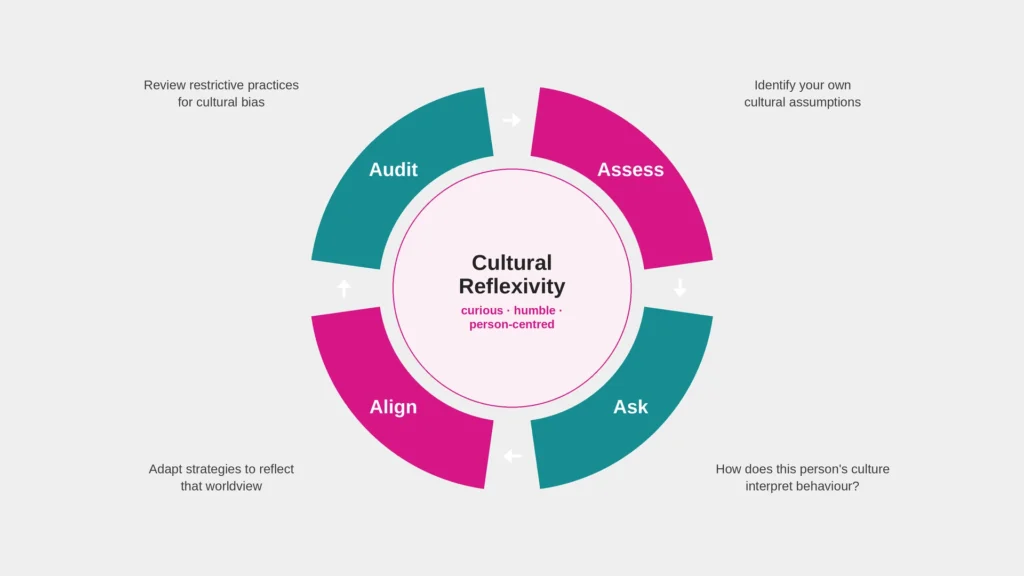
- Assess — Identify your own cultural assumptions first.
- Ask — How does this person's culture interpret this behaviour?
- Align — Adapt strategies to reflect that worldview.
- Audit — Review restrictive practices for cultural bias.
Cultural responsiveness in PBS was never framed as “getting it right.” It is lifelong humility, seeing context before judgement, valuing family and community knowledge, and building plans that fit the person's world rather than forcing them into ours.
Good reflexivity, better outcomes
Cultural reflexivity is not a checkbox. It is a continuous stance of curiosity that prevents us from replicating bias under the guise of “best practice.” If you take one thing from this, take this: pause before you pathologise, and ask before you assume.
One thing to sit with this month: what is one way you will bring cultural reflexivity into your next assessment, plan, or supervision session?
Refer to ORS. If you are supporting someone with behaviours of concern and want an assessment that genuinely accounts for culture, our positive behaviour support team works with participants, families and support coordinators across Australia. Referrals and enquiries are welcome.
Work with us. If this is how you like to practise — curious, humble and genuinely responsive to the people in front of you — you would fit in well here. Read about becoming a behaviour support practitioner or if you're a behaviour support practitioner looking to take your next step in your career, We'd love to hear from you! Simply fill out our one minute quick apply below and our team will be in touch.
Frequently Asked Questions
What is cultural reflexivity in positive behaviour support?
Cultural reflexivity is the ongoing practice of examining how our cultural values, professional training and personal assumptions influence how we interpret behaviour. It requires self-reflection on how our worldview shapes what we notice, critical awareness of who defines “normal,” and active adjustment of supports to align with a person's cultural context.
What is the difference between cultural competence and cultural humility?
Cultural competence assumes mastery of another culture, which risks overconfidence and stereotyping. Cultural humility instead emphasises lifelong learning, self-reflection, and accountability in the relationship — recognising that no practitioner can be fully “competent” in a culture that is not their own.
How does individualism versus collectivism affect PBS goals?
Many PBS frameworks are built on an individualistic lens that prioritises autonomy and independent choice. For clients from collectivist cultures, quality of life is often defined through family harmony and shared decision-making, so goals may need reframing from “independent choice” to “meaningful participation in shared family decisions.”
Can a cultural practice also be considered a restrictive practice?
Sometimes a cultural norm can look restrictive from the outside while holding deep relational or spiritual meaning for the person and family. Practitioners still operate under NDIS restrictive practice legislation, but should approach with curiosity about the practice's meaning and purpose before applying a compliance lens, and should document consent and rationale clearly.
How can I start building cultural reflexivity into my practice?
Start with the four-step habit from this training: assess your own cultural assumptions, ask how the person's culture interprets the behaviour in question, align your strategies to that worldview, and audit existing plans and restrictive practices for cultural bias. Building this into every assessment and supervision cycle turns it into a habit rather than a one-off reflection.


