


TL;DR. A Behaviour Support Plan (BSP) is a written, evidence-based document that explains what's driving a person's behaviour, or simply what would help them thrive, and sets out how everyone around them should respond, consistently and safely. It's not only for behaviours that carry a risk of harm. A BSP can just as easily be a proactive tool for building skills and quality of life. Either way, it's needed because knowing someone well isn't the same as having that knowledge tested against clinical evidence and written down so everyone applies it the same way. A BSP is built through proper assessment and collaboration with the participant, families, carers, and supports, and reviewed at least annually, more often if circumstances call for it. Every plan written by a Core-level practitioner is checked by a Report Reviewer, and our Quality Assurance team also reviews any plan that's more complex or higher-risk, regardless of who wrote it.
A Behaviour Support Plan (BSP) is a document built from assessment and evidence, not personal opinion. It explains what's driving a person's behaviour, or what would help them build new skills and independence. It sets out how everyone supporting that person should respond, so care stays consistent no matter who's involved on a given day. It doesn't take a risk of harm to make one worthwhile: a BSP is just as relevant when the goal is simply a better quality of life.
Some families, carers, and supports tell us they don't need one. That reaction usually comes from confidence, not resistance. They know the person well, they've managed day to day for years, and their instincts already work more often than not. That experience is valuable, and a BSP doesn't replace it. It captures that knowledge, tests it against clinical evidence, and turns it into something that holds up when circumstances change: a new support worker joins the team, the person moves between settings, or everyone's tired and falls back on whatever gets them through the moment.
What a Behaviour Support Plan Actually Does
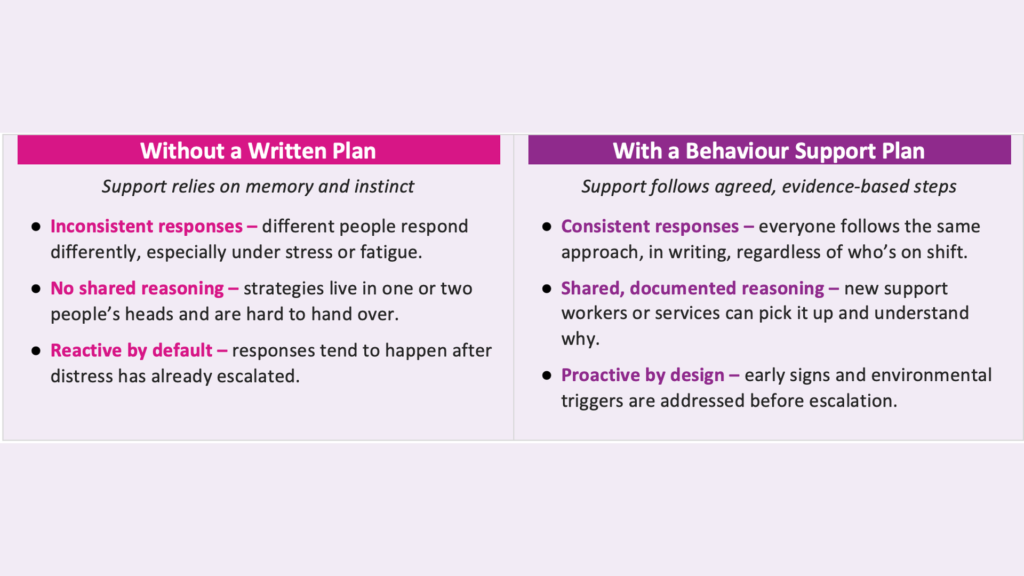
All behaviour happens for a reason. It's a form of communication. A BSP is built on a clinical assessment of what's driving a behaviour: what triggers it, what need it's meeting for the person, and what's most likely to help, based on evidence rather than a single household's trial and error. Without that written down, support tends to rely on memory, instinct, or moment-to-moment decisions. Even well-meaning responses can end up inconsistent between family, carers, support workers, and services, not because anyone is doing anything wrong, but because nobody has agreed, in writing, on what “the plan” actually is.
- It removes the guesswork: instead of everyone reacting after a behaviour has already escalated, the plan sets out how to notice early signs, what to adjust in the environment before things reach that point, and what skills to teach so the person has better ways to get their needs met over time, not only in the moment.
- It creates consistency: everyone supporting the person (family, carers, support workers, educators, allied health providers) works from the same agreed approach, described in enough detail that it doesn’t depend on asking one particular person because they’re the only one who knows what to do. This predictability is often calming for the person, and it removes the confusion that comes from mixed or contradictory responses.
- It builds accountability and learning: the plan documents which strategies are being used and tracks whether they’re working, backed by real data. Support can then evolve based on evidence of what’s helping, rather than repeating the same few things with no way to tell if progress is being made.
- It protects rights: if restrictive practices are ever necessary, the plan sets out exactly when they’re appropriate, why, for how long, and how they’ll be reduced and eventually removed. This keeps the person’s rights and dignity central, and keeps support aligned with United Nations Convention on Rights of Persons with a Disability, NDIS requirements and best-practice standards rather than relying on ad hoc decisions made under pressure.
Used this way, a BSP is preventative rather than reactive. It can catch small things early, before they ever grow into a behaviour of concern, and it builds the person’s own skills and independence along the way, rather than only stepping in once something has already become a problem.
In short, a BSP turns “what we think works” into “what we know works, why it works, and how we all apply it the same way.” It isn’t an optional extra or paperwork for its own sake. It’s the framework that keeps support consistent, defensible, and focused on the person’s quality of life, long after the conversation that created it is over.
What Changes With and Without a Plan
It can help to see the difference side by side. Neither column assumes anyone is doing a bad job. It’s about what a documented, clinically informed approach adds on top of good intentions.
How a Behaviour Support Plan Is Built
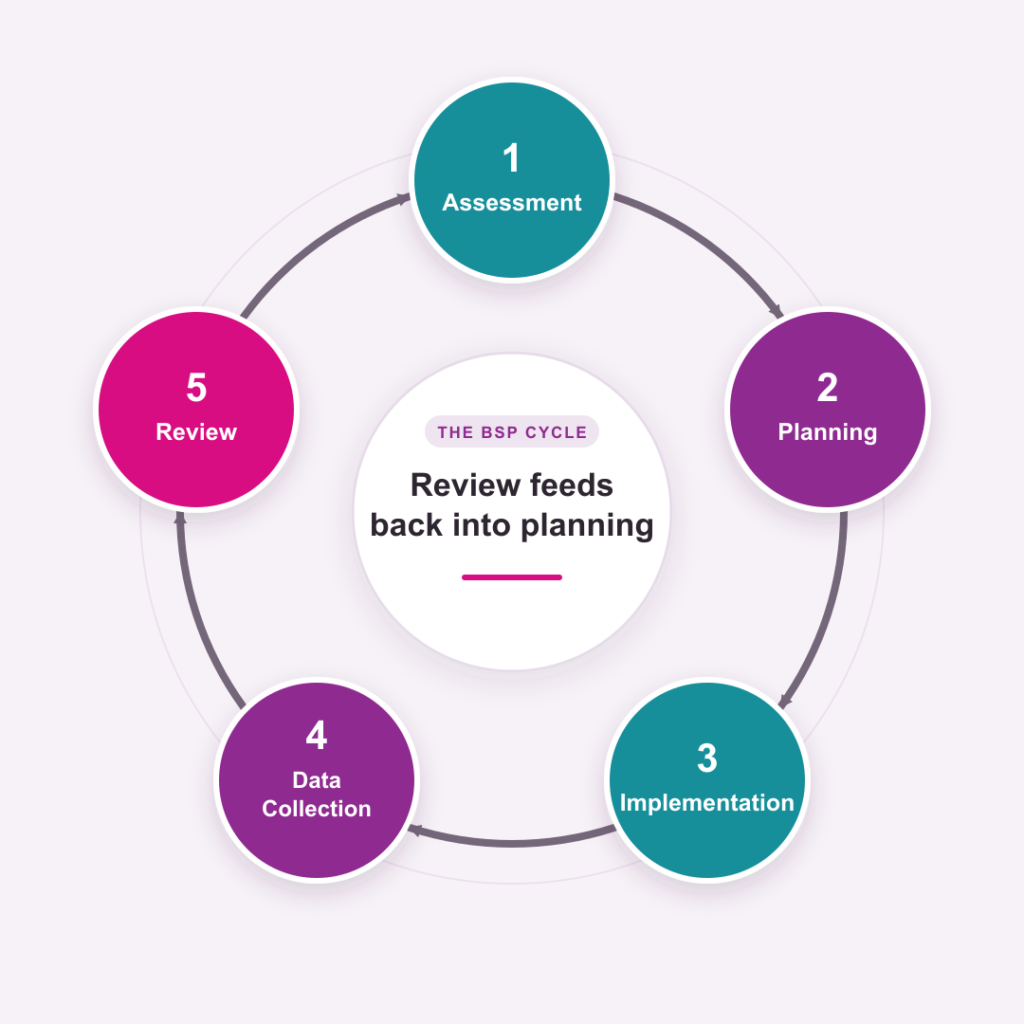
A BSP isn’t written in isolation by one person guessing at what might help. It follows a consistent process that starts with proper assessment and data, and loops back around to review as the person’s life changes.
Assessment
We begin with a Behaviour Support Assessment, which includes a Functional Behaviour Assessment (FBA). The Behaviour Support Assessment takes a bio-psychosocial lens, looking at biological, psychological, and social factors together, while the FBA looks specifically at the behaviour itself: what happens right before it, what happens right after, and what function it’s serving for the person, whether that’s escape, attention, access to something, or a sensory need. Together, they combine direct observation, conversations with the person and the people who know them best, and a look at any existing records, so we’re building a full, accurate picture before a single strategy is proposed. This is the foundation everything else is built on. Without a proper assessment, there’s nothing for a plan to be evidence-based about.
- Reviewing what already exists: existing reports, medical history, previous plans, and records already held by other providers or services, so we’re not starting from scratch or duplicating work that’s already been done.
- Talking to the people who know the person best: family, carers, support workers, educators, and other allied health professionals, alongside the person themselves wherever possible. Their perspective on what’s happening and why is central, not incidental.
- Direct observation, across more than one setting: this is one of the most valuable parts of assessment. We look at where a behaviour does happen, and just as importantly, where it doesn’t. Comparing behaviour across different environments, times of day, and people helps us identify what’s driving it, instead of assuming it’s simply about the person in isolation. A behaviour that only shows up in one setting is telling us something quite different to one that shows up everywhere.
- Baseline data collection: before any strategy is introduced, we gather a clear picture of how often a behaviour is happening, how intense it is, and what tends to come before and after it. This baseline is what everything else gets measured against. Without it, there’s no way to know later whether a strategy has made a difference, and no way to catch it if things are quietly getting worse rather than better.
Together, record review, conversation, cross-setting observation, and baseline data are what make a BSP evidence-based rather than a best guess, and they don’t stop once the plan is written. The same data collection continues throughout implementation and feeds directly into review, so the picture we’re working from stays accurate instead of going stale.
Planning
Using what the assessment uncovered, we design strategies that are appropriate to the person and their circumstances, not a generic, one-size-fits-all template. Every strategy sits at the intersection of two things: it’s person-centred, and it’s evidence-based.
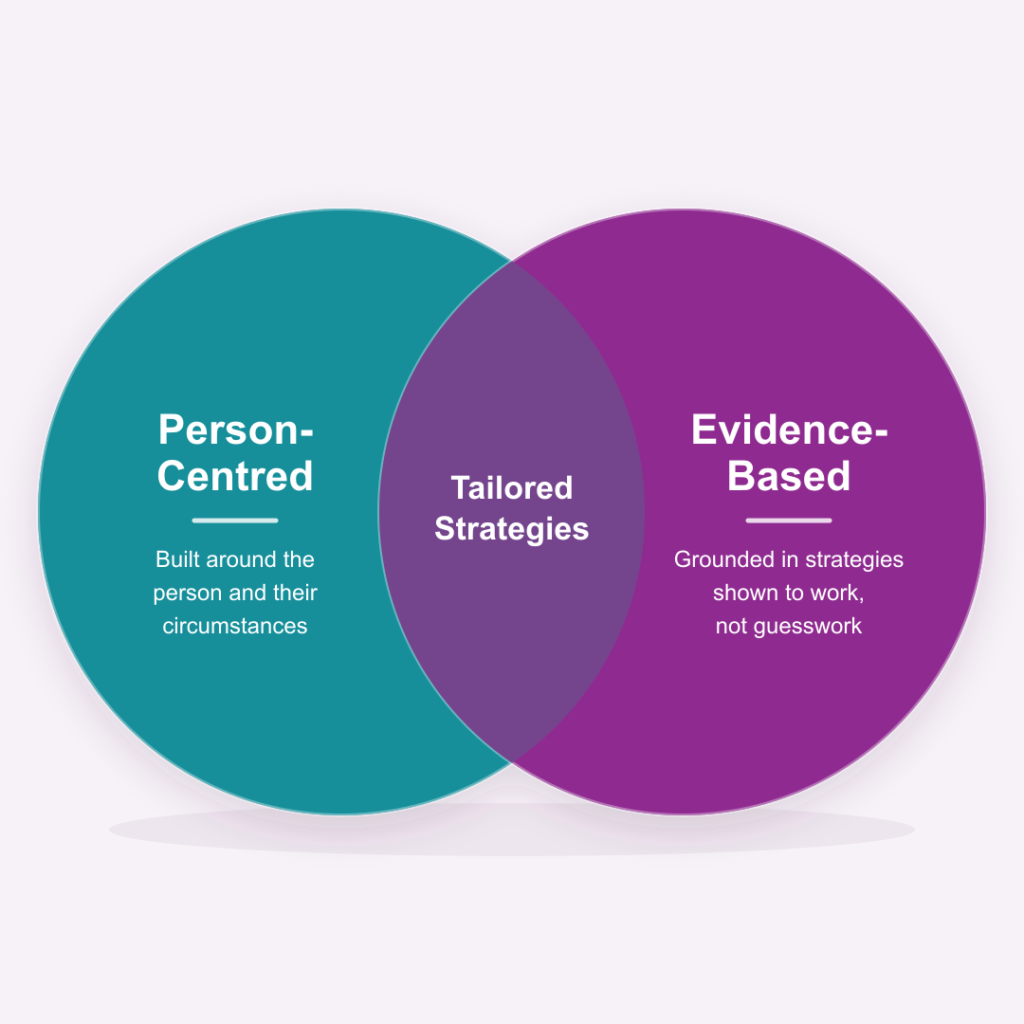
Person-centred means the plan reflects the individual’s strengths, preferences, communication style, sensory needs, and the day-to-day realities of their environment. Evidence-based means every strategy is drawn from approaches shown to work in behaviour science, not guesswork, tradition, or trial and error. If a strategy is in the plan, we can explain why it’s there and what it’s expected to achieve, which is what makes a BSP defensible rather than a matter of opinion.
The Rest of the Process
Assessment and planning are where a plan’s evidence base is built, but the process doesn’t stop there. Once a plan exists, four more stages carry it through to real life:
- Coaching – we work directly with the people implementing the plan day to day (family, carers, support workers, educators, or others), so everyone feels confident putting it into practice, not just reading it.
- Implementation – the plan comes to life, often starting with direct skill-building alongside the person, then transferring those skills across every setting they’re part of.
- Data Collection – we track whether strategies are working, using a method that fits real life, so adjustments are based on evidence rather than impressions.
- Review – covered in full below, this is what keeps the plan alive and loops the process back into planning as things change.
A Plan That Grows With the Person, Not One That Sits on a Shelf
A common worry is that a BSP becomes “just another document”, written once, filed away, and never looked at again. That’s exactly what the annual review is designed to prevent, and it’s also where the process loops back around into planning. Generally, plans are reviewed at least annually. However, individual circumstances can call for earlier or more frequent reviews, and your PBS practitioner will advise you on what’s right for your specific needs. In practice, that often means formally sitting down with the person’s support network every 10-12 months to review both the plan itself and how it’s gone since it was last updated. This isn’t a fixed compliance deadline. It’s driven by the quality of the plan and how well it’s working, which means review can happen sooner if something isn’t landing, or if circumstances change unexpectedly.
The annual review is a real, collaborative conversation, not a form filled out from a desk. Together, we work through:
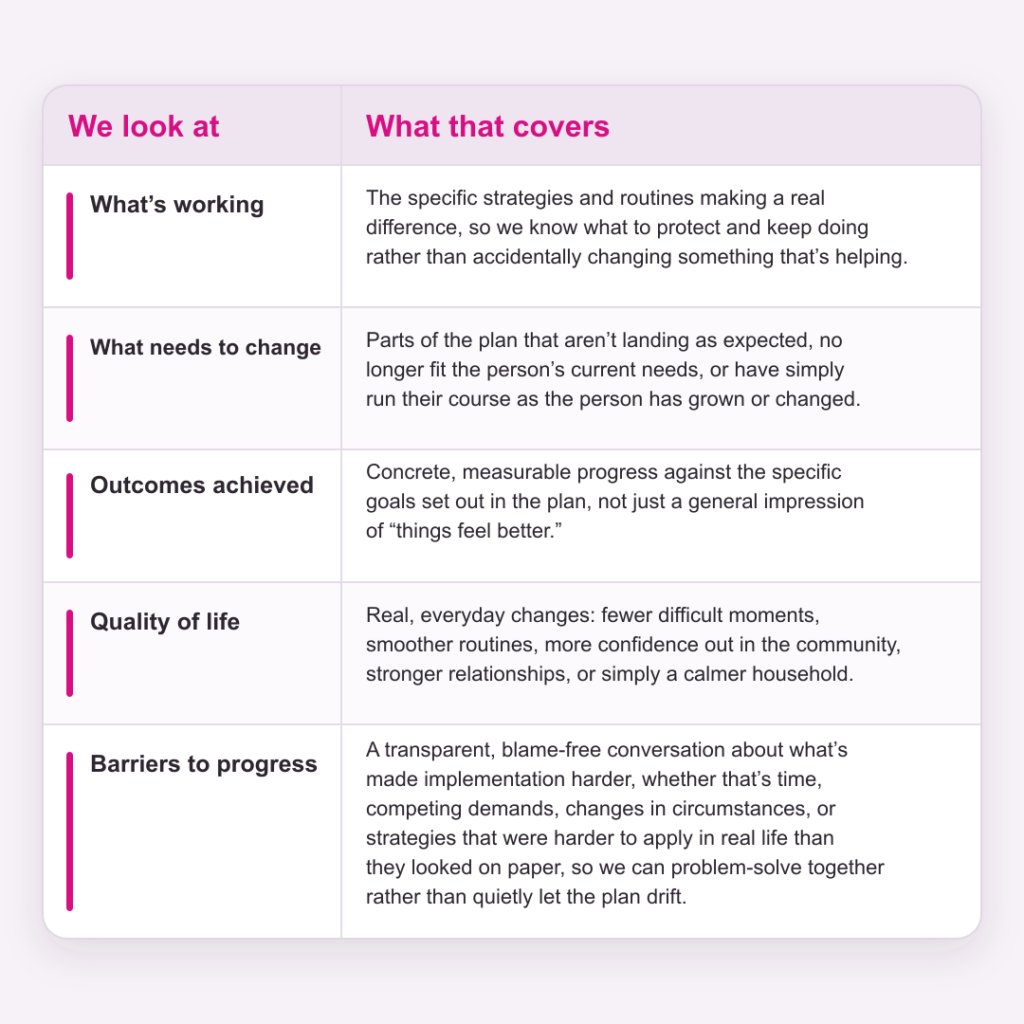
From this review, the plan is updated, refined, or built on so it keeps reflecting the person as they are now, not as they were at the last review. People grow, circumstances change, and new challenges or goals emerge. The plan is meant to evolve alongside the person, not stay frozen in time, and this step is what feeds straight back into planning. A plan that’s never reviewed can quietly become outdated even if it was excellent on the day it was written. Regular review is what protects the progress already made and builds on it, rather than letting it slowly erode.
How We Check a Plan’s Quality
Because a BSP carries real weight for the person, their family and carers, and everyone tasked with implementing it, we don’t leave its quality to individual judgement alone, however experienced a practitioner is. Every plan written by a Core-level practitioner is reviewed by a Report Reviewer, in line with the supervision requirements set out in the NDIS PBS Capability Framework. On top of that, our internal Quality Assurance team reviews any plan that’s more complex or higher-risk, regardless of the practitioner’s level of experience. This is a rigorous check that looks at both how the plan is written and whether the clinical reasoning behind it stands up:
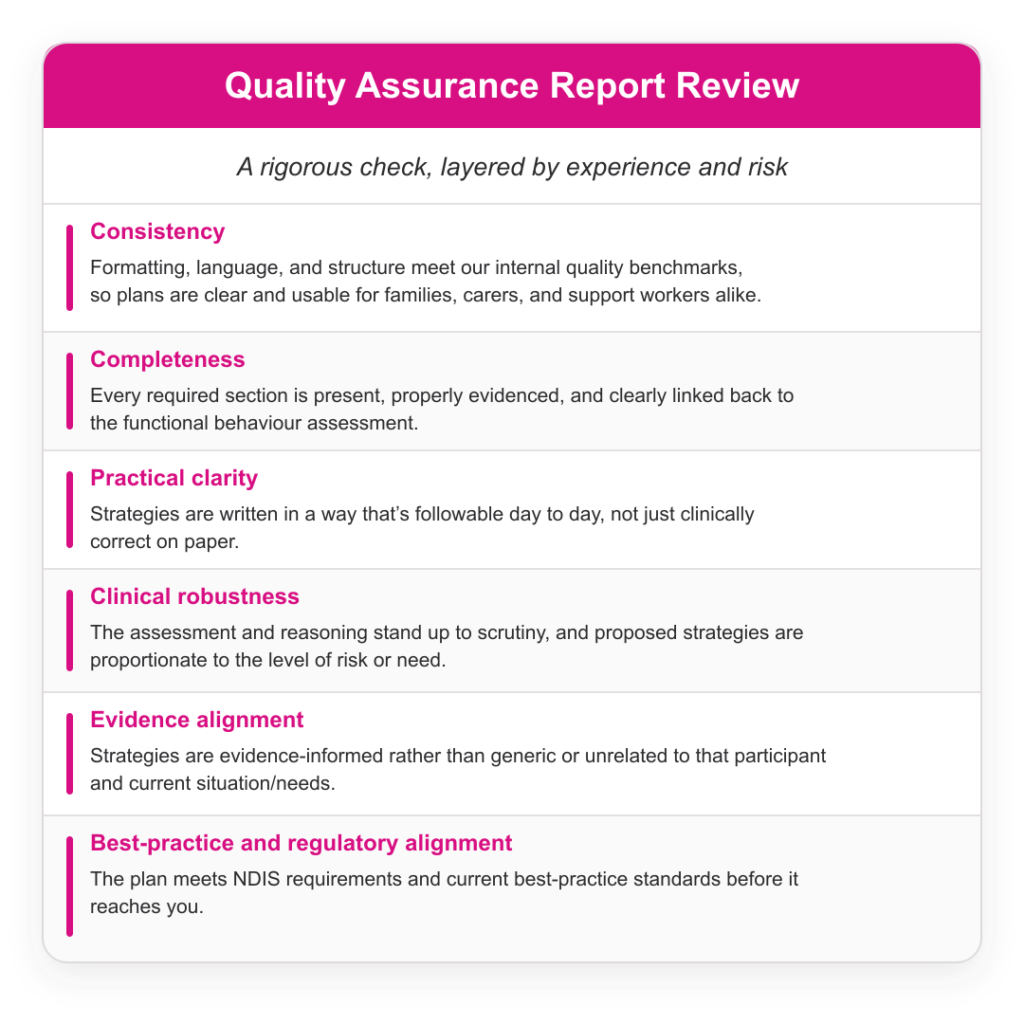
This layered approach, our QA team’s review of complex and higher-risk plans, plus the wrap-around clinical support every ORS practitioner receives regardless of years of experience, is part of what sets ORS apart. It’s a significant reason we’re able to develop some of the best BSPs in the industry: quality isn’t left to chance at any level, from a practitioner’s first plan through to their most complex specialist work.
When a Plan Includes Restrictive Practices
A restrictive practice is any strategy that limits a person’s rights or freedom of movement in order to manage a behaviour. The NDIS Commission regulates five specific types, and they’re only included in a plan as a last resort in response to a real risk of harm, after less restrictive options have been tried, and always alongside a clear plan to reduce and eventually remove them.
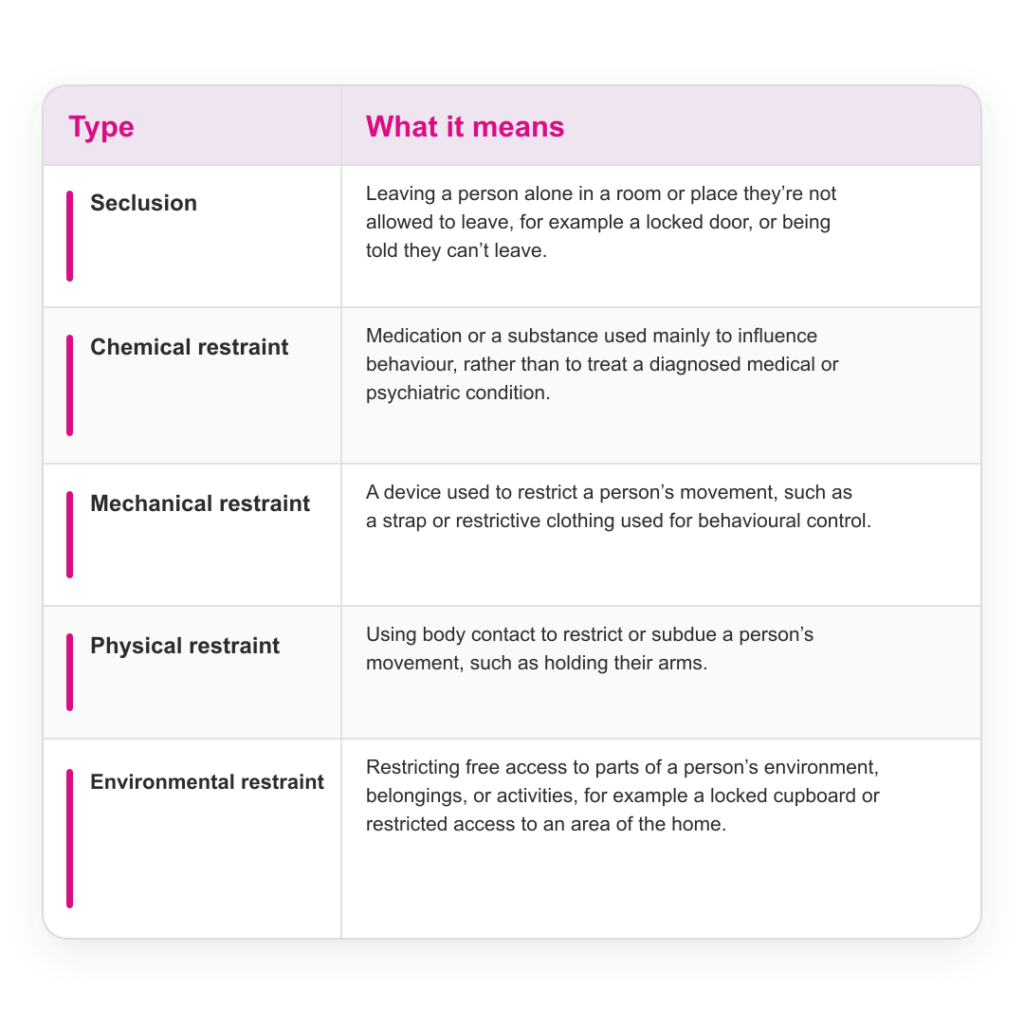
Because a restrictive practice limits a person’s rights, its use is never left to a provider’s discretion alone. It’s bound by legislative and regulatory processes and deadlines that sit outside our control, before, during, and after it’s written into a plan:
- Authorisation before use: a restrictive practice generally needs to be authorised through a state or territory authorisation process, separate to being written into the plan itself. The plan alone doesn’t make its use lawful.
- Tighter development timeframes: when a restrictive practice is involved, an interim plan is due within one month of engaging a specialist behaviour support provider, and a full, comprehensive plan within six months, shorter timeframes than apply to a plan without restrictive practices.
- Lodgement with the NDIS Quality and Safeguards Commission: any plan containing a restrictive practice must be submitted to the Commission, which oversees restrictive practice use nationally, not just at the level of an individual plan.
- Ongoing monthly reporting: use of a restrictive practice is reported to the Commission on a monthly basis, so it stays visible on an ongoing basis rather than only being checked in at review time.
- Mandatory reporting of unauthorised use: if a restrictive practice is ever used without proper authorisation, it must be reported to the Commission as a reportable incident within five business days.
- Annual review and update: any plan containing a restrictive practice must be formally reviewed and updated at least annually. This is a legislated requirement, not a discretionary timeframe, and it applies regardless of how well the plan is otherwise working.
- Ongoing scrutiny of the practice itself: beyond the whole-plan review, the specific restrictive practice is subject to its own additional layer of review, given the elevated risk and rights implications of using it. It has to keep earning its place in the plan at every review, not simply carry over from one version to the next.
This extra layer of regulation exists because restrictive practices restrict a person’s rights, and that can never be treated as routine. It sits on top of, not instead of, the quality and review processes already described. If a plan you’re involved with contains a restrictive practice, you can expect more oversight of it, not less, and a standing focus on reducing and eventually eliminating its use altogether.
For More Info on Restrictive Practices
Check out the NDIS Quality and Safeguards Commission’s own guides for further detail beyond what’s covered here:
We already know what works. Do we really need a written plan?
Knowing what works is exactly why a BSP is worth having. It takes that hard-won knowledge and captures it properly, so it isn’t lost when circumstances change, a new support worker joins, or the person’s needs shift as they grow. Without it, that expertise stays locked in one or two people’s heads instead of being shared consistently, and safely, across everyone involved in the person’s life.
Won’t the plan just become a document that sits in a drawer?
Regular review is what stops that. As covered above, we come back to the plan on a genuine schedule, not an afterthought, and check honestly what’s working before updating it to reflect the person as they are now, not as they were when it was written.
Who makes sure the plan is any good?
Every plan written by a Core-level practitioner is reviewed by a Report Reviewer, as required under the NDIS PBS Capability Framework. Our Quality Assurance team also checks any plan that’s more complex or higher-risk, regardless of the practitioner’s experience. No plan is signed off purely on one person’s say-so.
What if the plan isn’t working for us?
That’s exactly what review is for, and it doesn’t have to wait for a scheduled date. Barriers and strategies that aren’t landing are raised and discussed openly, without blame, and the plan is adjusted so it works better going forward. If something is clearly not working, review can happen earlier than the usual timeframe.
Isn’t a BSP just for behaviours that are dangerous or extreme?
No. It’s just as relevant for behaviours that are disruptive or distressing, or that get in the way of everyday life at home, school, work, or in the community. The goal is to understand and support, not just to intervene once things become a crisis.
There’s no risk of harm or behaviour of concern. Do we still need a plan?
Often, yes, just for a different reason. Rather than managing risk, the plan focuses on goals like new skills, greater independence, or a smoother day-to-day life. Getting that written down and agreed on early can also stop small things from ever turning into a behaviour of concern down the track.
Will a BSP change how we already do things at home?
Not necessarily. A good plan starts by capturing what’s already working for your family, carers, and supports, and builds from there. It’s far more common for a BSP to formalise and strengthen your existing approach than to replace it with something unfamiliar.
Refer to Us. If you’re supporting someone who could benefit from a Behaviour Support Plan and want the assessment done properly, our positive behaviour support team works with participants, families, carers, and support coordinators across Australia. Referrals and enquiries are welcome.
Work with Us. If this is how you’d like to practise one day, curious, evidence-led, and person-centred, you’d fit in well here. Read about becoming a behaviour support practitioner or explore use the form below to quick apply.


