Positive Behaviour Support
Helping people reduce behaviours of concern so they can live safer, more independent lives
Positive Behaviour Support
What is Positive Behaviour Support under the NDIS?
Positive Behaviour Support (PBS) is an evidence-based approach that focuses on understanding why behaviours of concern occur, and developing practical, person-centred strategies to improve safety, independence and quality of life for individuals and their support networks.
Rather than simply managing behaviours, PBS identifies underlying needs and environmental factors driving behaviour, then builds functional skills, communication, and support strategies that reduce risk and improve daily functioning. This includes reducing reliance on restrictive practices and creating more consistent, supportive environments across home, school, and community settings.
Evidence-based
Every strategy is grounded in clinical research and aligned with NDIS Practice Standards for Behaviour Support, ensuring safe, consistent and defensible decision-making. So participants receive safe, reliable support that families can trust.
Person-centred
Plans are co-designed with the participant, their family, carers and support team to ensure strategies are practical, achievable and work in real-world environments. So support fits daily life, not just a clinical setting.
Whole-of-life
Support extends across home, school, work and community settings to ensure consistent implementation and reduce behavioural variation across environments. So progress is consistent no matter where the person is.
Outcome-focused
Regular data monitoring and clinical review ensure strategies remain effective, responsive to change and focused on reducing behaviours of concern over time. So support adapts as needs change and improvements are sustained.
Who We Support
Positive Behaviour Support is effective for children, adolescents and adults with disabilities who are experiencing behaviours of concern that impact safety, daily functioning, or participation in everyday life.
Disabilities we support
Autism Spectrum Disorder
A lifelong developmental condition that affects communication, social interaction, sensory processing, and how a person experiences the world around them.
Intellectual Disability
A condition that affects learning, reasoning, problem-solving, communication, and everyday adaptive skills.
ADHD
Attention-Deficit/Hyperactivity Disorder — a condition affecting focus, attention, impulse control, emotional regulation, and activity levels.
Acquired Brain Injury / Traumatic Brain Injury
Damage to the brain occurring after birth, often impacting memory, thinking, behaviour, movement, emotions, or communication.
Down Syndrome
A genetic condition present from birth that may affect intellectual development, learning, physical growth, and overall health.
Psychosocial disability
Disability arising from long-term mental health conditions such as schizophrenia, bipolar disorder, anxiety, depression, or PTSD that impact daily functioning.
Fetal Alcohol Spectrum Disorder
A lifelong condition caused by alcohol exposure before birth, affecting learning, behaviour, memory, attention, and emotional regulation.
Dementia
A group of conditions causing progressive decline in memory, thinking, behaviour, communication, and daily functioning.
Sensory processing differences
Differences in how the brain processes sensory information such as sound, touch, movement, light, taste, or texture.
Behaviours we can help you manage
Aggression or escalating behaviour
Behaviours that may involve yelling, threatening actions, intimidation, or physical aggression when a person feels overwhelmed, distressed, unsafe, or unable to regulate emotions.
Self-injury
Behaviours where a person intentionally harms themselves, often as a way to cope with emotional distress, sensory overload, frustration, or communication difficulties.
Emotional dysregulation or distress behaviours
Intense emotional responses that can make it difficult to manage feelings, cope with change, communicate needs, or participate in everyday activities.
Property damage
Behaviours involving breaking, throwing, or damaging objects, often linked to distress, frustration, communication barriers, or emotional overwhelm.
Absconding or unsafe wandering
Leaving safe environments unexpectedly or moving without awareness of danger, which can place a person at risk of harm or becoming lost.
Withdrawal or disengagement
Pulling away from people, activities, communication, or support due to anxiety, low mood, trauma, overwhelm, fatigue, or social difficulties.
School refusal
Difficulty attending school due to anxiety, emotional distress, sensory challenges, bullying, trauma, or other barriers affecting participation and wellbeing.
Verbal escalation
Raised voices, yelling, arguments, or heightened emotional communication that may occur during periods of stress, frustration, or emotional overload.
Risk-taking or unsafe behaviours
Behaviours that may place a person or others at risk, including impulsive actions, unsafe decision-making, or reduced awareness of danger.
Service Options
How we can support you
Whether you are starting PBS for the first time, need ongoing intervention, or require support for an NDIS plan review, we provide flexible service options tailored to your needs.
Assessment & Behaviour Support Plan
Comprehensive functional assessment + tailored Behaviour Support Plan.
- Functional Behaviour Assessment
- Co-designed Behaviour Support Plan
- Strategy development & documentation
- NDIS-compliant reporting (as required)
- Restricted Practice Identification (as required)
Assessment, Plan & Ongoing Intervention
End-to-end support — implementation, training, and review.
- Full assessment & Behaviour Support Plan development
- Practitioner-led implementation
- Family & stakeholder training
- Data monitoring & plan reviews
- Support reduction of restrictive practices
Recommendation Letter to inform NDIS Plan Review
Clinical reports to support NDIS plan reviews and funding requests.
- Clinical justification & evidence
- NDIS-ready documentation
- Specific funding recommendations
- Plan review support
how it works
A clear path from referral to support
1
Referral & Intake
Fast onboarding and practitioner matching based on participant needs and complexity.
2
Functional Assessment
Understanding triggers, environment, history, and unmet needs.
3
Behaviour Support Plan
Co-designed, practical, evidence-based strategies for everyday environments.
4
Implementation & Training
Strategies understood and consistently applied across all settings.

Funding and Service Delivery
PBS is funded under the NDIS Capacity Building budget (Improved Relationships).
If your current plan does not include PBS funding, our team can support you to prepare for your next plan review by providing supporting evidence, recommendation reports, and guidance through the process.
Other funding pathways:
- Early Childhood Intervention
- Privately funded services
- Government contracts (e.g. DCJ / children in out-of-home care)
Centre of Excellence
Industry-leading quality built into every plan.
Our Centre of Excellence strengthens the quality, consistency, and safety of Positive Behaviour Support across ORS.
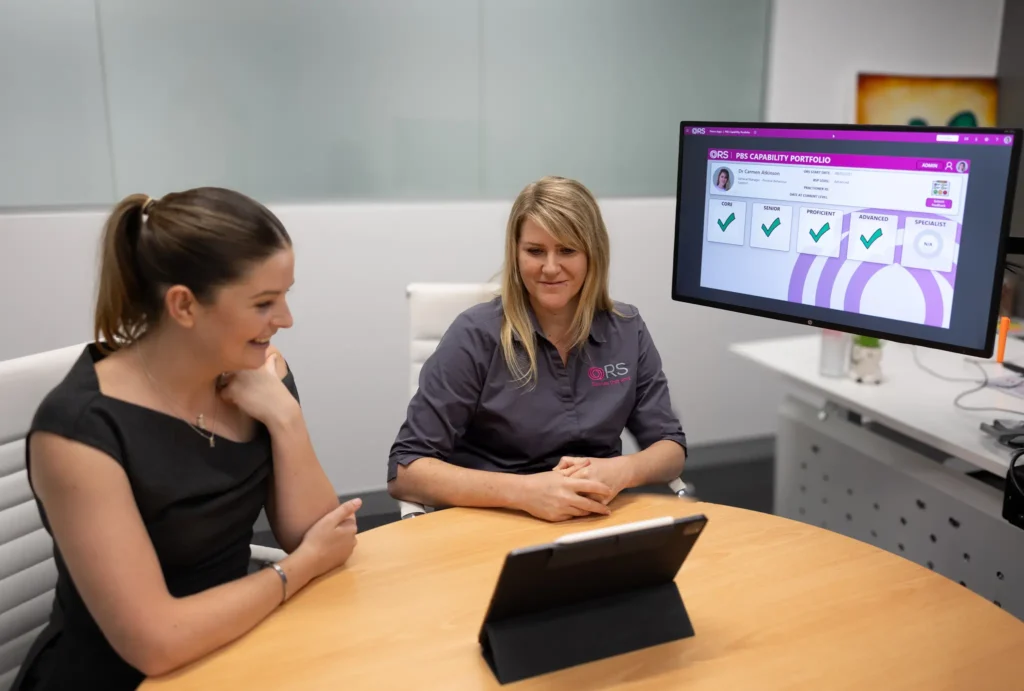
It ensures every Behaviour Support Plan is developed using structured clinical frameworks, evidence-based practice, and ongoing professional support for our practitioners.
Continuous clinician development
Our practitioners receive ongoing training in PBS best practice, NDIS Behaviour Support requirements, and complex case management to ensure high-quality, up-to-date practice.
Evidence-based clinical frameworks
We use structured assessment and intervention frameworks to guide consistent, safe, and high-quality decision-making across all Behaviour Support Plans.
Multidisciplinary collaboration
Psychologists, occupational therapists, and speech pathologists work together on complex cases to ensure behaviour is understood from all contributing perspectives.
Clinical supervision and peer support
Regular supervision and peer review help maintain consistency, strengthen clinical reasoning, and support continuous improvement across our team.
Arthur's Story
Arthur was referred to ORS to help build his confidence in speaking with others due to a condition called Selective Mutism. ORS’ Positive Behaviour Support State Manager, Erin Bowcock, walks us through Arthur’s journey, and he tells us how he “feels so much happier” after receiving this life-changing support from ORS.
Video Transcript
00:00–00:00:34 · Erin Bowcock (Regional Manager for Positive Support – ORS): Hi, my name is Erin Bowcock and I'm a Regional Manager for Positive Behaviour Support at ORS. Arthur was referred for support to help build his confidence in speaking with others. Arthur was experiencing selective mutism — an anxiety disorder that affects how people speak to certain types of people. In Arthur’s case, he could not speak in front of people he did not know.
00:00:34–00:00:54 · Arthur (NDIS Participant): Hi, I’m Arthur from Blacktown. Erin has been helping me with my confidence in speaking, and she’s been quite good at teaching me to be confident.
00:00:54–00:01:17 · Erin Bowcock: Support after and building his confidence in speaking with people that he didn't know. We used a range of positive behaviour support strategies focused on understanding the underlying cause of his anxiety and working through it to make the best experience for Arthur. Each session was person-centred, and Arthur responded really well to a fun, bubbly nature.
00:01:17–00:01:53 · Erin Bowcock: In each session, right from the start, we came in with smiles and lots of fun games so that he’d enjoy the sessions and learn the skills and strategies being implemented. We have completely changed Arthur’s life. I'm incredibly proud of his progress — from not being able to communicate with strangers to confidently starting conversations and sharing about himself — a truly amazing feat.
00:01:53–00:02:07 · Arthur: It makes me feel better talking to people I couldn’t speak to before. I’ve made more friends now and I feel so much happier.
00:02:07–00:02:29 · Erin Bowcock: Following behaviour support services, Arthur’s quality of life has improved significantly. He's now able to speak to his supports and ask for what he wants, assert himself at home, and confidently meet new people — leading to a much more positive life.
Frequently asked questions
What is a Behaviour Support Plan?
A Behaviour Support Plan (BSP) is a personalised, evidence-based document that outlines strategies for understanding and reducing behaviours of concern. It includes proactive strategies, environmental adjustments, skill-building approaches, and guidance on reducing restrictive practices where appropriate.
How long does Positive Behaviour Support take?
Most participants begin to see meaningful change within 3 to 6 months. The initial assessment and Behaviour Support Plan development typically takes around 4 weeks, depending on complexity. Ongoing support can continue for as long as it is needed and funded under the participant’s NDIS plan.
Can adults access Positive Behaviour Support?
Yes. PBS is effective across the lifespan, including children, adolescents, adults, and older adults. We support participants across home, community, school, workplace, and supported accommodation settings.
Do I need a diagnosis to access PBS?
No. A formal diagnosis is not required. What matters is that behaviours are impacting safety, participation, or quality of life. Our practitioners complete a functional assessment to understand individual needs.
How do I get PBS funding in my NDIS plan?
PBS is typically funded under the Capacity Building budget in the Improved Relationships category of your NDIS plan. If PBS is not currently included, we can provide supporting evidence and recommendation reports to assist with your next plan review.
What is the difference between Positive Behaviour Support and ABA (Applied Behaviour Analysis)?
Positive Behaviour Support (PBS) is a person-centred approach that focuses on improving someone’s overall quality of life, not just changing their behaviour. ABA is a scientific method focused on behaviour change through reinforcement. PBS builds on some ABA principles but wraps them in a human rights framework, it never uses punishment-based strategies and always works toward reducing and eliminating restrictive practices. Under the NDIS, all behaviour support must be delivered within a PBS framework.
What is the difference between Positive Behaviour Support and Psychology?
Behaviour support focuses on improving quality of life and reducing behaviours of concern using a broad range of evidence-based approaches. This includes a large focus on changing the environment and working with a participant’s supports. Behaviour support practitioners come from diverse allied health and professional backgrounds and are registered through the NDIS Commission. Psychology focuses on the assessment and treatment of mental health presentations and psychologists are registered through the Australian Health Practitioner Regulation Agency (AHPRA).
Do Positive Behaviour Support services work with my existing supports e.g. day program, occupational therapy?
Yes, positive behaviour support practitioners work with existing supports across different environments including the home, education and activities in the community. With a participant’s consent, all supports are consulted in the development of the plan and are provided training on the implementation of strategies.
What is a restrictive practice?
A restrictive practice is any practice or intervention that has the effect of restricting the rights or freedom of movement of a person with a disability. Restrictive practices may only be used as a last resort to protect a person with a disability or others from harm. The use of restrictive practices must be outlined in a Behaviour Support Plan.
Can Positive Behaviour Support help with autism, ADHD, or intellectual disability specifically?
Yes. PBS is commonly used for people with autism, intellectual disability, AUHD, ADHD, and other developmental conditions. It is also used for people with acquired brain injury, mental health conditions, and complex support needs. The approach is always tailored to your family member’s specific strengths, needs, and goals, there is no one-size-fits-all plan.
Do Positive Behaviour Support services include training?
Yes, positive behaviour support services will include training on the Behaviour Support Plan that has been individually developed for a participant. This can include training for family members, support staff, teachers, day program staff and allied health practitioners. Training is also provided to the participant.
Videos
Blogs





Downloads